
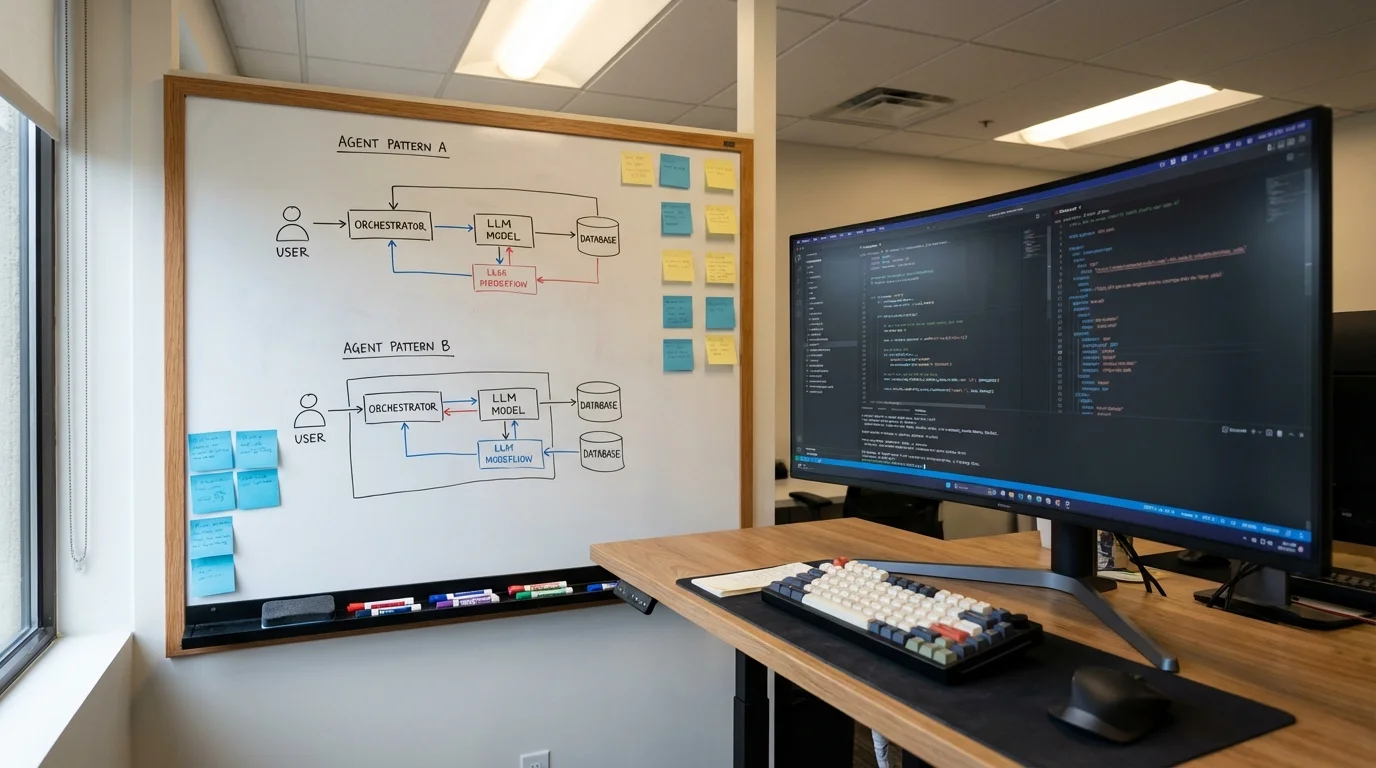
Function calling is direct and deterministic, ideal for structured tasks where you know which tools are needed upfront (API integrations, form processing, data extraction). ReAct agents reason iteratively, choosing tools dynamically based on intermediate results, better for exploratory tasks, multi-step research, and situations where the path to solution isn't predetermined. Function calling costs less, runs faster, and is easier to debug. ReAct handles ambiguity better but burns more tokens and can loop unproductively. Most production systems benefit from hybrid approaches: ReAct for planning and function calling for execution.
A trading assistant built with ReAct-style reasoning sounds elegant, the agent thinks through each step, executes tools, observes results, and iterates until reaching an answer. But when every simple portfolio lookup triggers 8-12 reasoning cycles, users wait 15 seconds for information that should take 2. Meanwhile, a cruder system using direct function calling executes the same request in under a second at one-tenth the cost.
This tradeoff defines the core architectural decision in AI agent design: function calling versus ReAct patterns. Function calling is direct and deterministic, fast but inflexible. ReAct is adaptive and exploratory, powerful but expensive. Choosing the wrong pattern creates systems that are either too slow and costly, or too rigid and limited.
The right choice depends on task characteristics, not technology preferences. Understanding when each pattern excels, and when to combine them, separates production-ready agent systems from expensive experiments. For foundational context, see our guide on how to build complex AI agents.
Understanding Function Calling: Direct Tool Execution
Function calling is the straightforward pattern: you describe available tools to an LLM, it analyzes the user's request, and it outputs which function to call with which parameters. The model makes one decision, you execute it, and you return the result. No iteration, no intermediate reasoning steps, just direct tool selection and execution.
How Function Calling Works
When you configure function calling, you provide the model with a schema describing your available tools, names, descriptions, parameters, and types. Given a user request, the model outputs a structured response specifying which function to invoke and what arguments to pass. For example, if a user asks "What's the weather in Tokyo?", the model analyzes this against your tool definitions and outputs something like: {"function": "get_weather", "arguments": {"location": "Tokyo"}}. Your code executes this function call and returns results to the user. The model never sees intermediate results or adjusts its approach. It makes one tool selection decision based solely on the user's input and tool descriptions. For guidance on making this work reliably, see how to make AI agents use tools correctly.
Strengths of Function Calling
Deterministic execution: Given the same input and tool definitions, function calling produces predictable outputs. This makes testing straightforward and debugging tractable. You can map inputs to expected function calls and verify behavior systematically. Low latency: One LLM call, one function execution, one response. Users get answers in 1-3 seconds for most operations. There's no reasoning overhead, no observation loops, no iterative refinement adding latency. Cost efficiency: You're paying for one model inference per request. For high-volume applications handling thousands of daily requests, this difference compounds significantly. A system processing 10,000 queries daily at $0.03 per inference costs $300/day with function calling versus potentially $1,500-3,000/day with ReAct. Simple error handling: When function calling fails, you know exactly where it failed. The model selected the wrong function, or passed invalid parameters, or the function execution errored. Each failure mode has a clear location in your system.
Limitations of Function Calling
Single-step reasoning: The model must decide everything upfront. It can't explore one path, learn something, and adjust. If the correct approach depends on intermediate information, function calling struggles. Brittle with ambiguity: When user requests map to multiple possible tools or require contextual judgment, function calling often picks wrong. It lacks the observational feedback loop that helps agents refine their understanding. No adaptive problem-solving: Complex tasks requiring multiple tools in sequence, where each step informs the next, don't fit function calling's one-shot model. You either chain calls explicitly in your code, or you build rigid workflows that can't adapt.
Understanding ReAct: Reasoning and Acting in Loops
ReAct agents alternate between reasoning about what to do and taking actions based on that reasoning. The name comes from "Reason + Act", the agent thinks, acts, observes results, thinks again, and continues until reaching a satisfactory answer or hitting a stopping condition.
How ReAct Works
A ReAct agent processes requests through iterative cycles. First, it reasons about the task: what information is needed, which tools might help, what approach makes sense given current knowledge. Then it takes an action, typically calling a tool. It observes the result of that action. Based on this observation, it reasons again: did that help? What's still unknown? What should happen next? This loop continues until the agent determines it has enough information to answer, or until it hits configured limits on iterations or token usage. For details on setting these limits, see our guide on AI agent reasoning loops and step optimization. For example, given "Compare our Q3 revenue to competitors", a ReAct agent might: (1) reason that it needs internal revenue data first, (2) call get_quarterly_revenue(quarter="Q3"), (3) observe the result showing $4.2M, (4) reason that it now needs competitor data, (5) call search_competitor_financials(quarter="Q3"), (6) observe that competitor data requires multiple sources, (7) reason about which competitors matter most, and continue until it can synthesize a complete comparison.
Strengths of ReAct
Adaptive problem-solving: ReAct agents adjust their approach based on what they learn. If one tool doesn't return useful results, they try another. If information is incomplete, they seek additional sources. This flexibility handles ambiguous and complex tasks that rigid pipelines can't. Transparent reasoning: The explicit reasoning steps create interpretable traces. You can see why the agent chose each action, not just what it did. This helps with debugging, auditing, and building user trust in agent decisions. Multi-step task handling: Tasks requiring sequential tool use with dependencies between steps are natural for ReAct. Each observation informs subsequent reasoning, allowing the agent to navigate complex workflows dynamically. Better error recovery: When a tool fails or returns unexpected results, ReAct agents can reason about what went wrong and try alternative approaches. Function calling typically fails hard on unexpected situations.
Limitations of ReAct
Higher latency: Each reasoning cycle requires an LLM inference. Five reasoning steps means five model calls before returning results. For simple tasks, this overhead is unnecessary and frustrating for users expecting quick responses. Token cost multiplication: Every reasoning step adds tokens, both for the model's reasoning output and the growing context that includes all previous observations. A 10-step ReAct trace can consume 10-20x the tokens of equivalent function calling. For cost optimization strategies, see reducing LLM token costs. Loop risks: ReAct agents can get stuck in unproductive loops, repeatedly calling the same tools, oscillating between approaches, or continuing to reason without making progress. Without careful limits, agents can burn through budgets on futile reasoning cycles. Harder to debug: When ReAct fails, you have a long trace to analyze. Did reasoning go wrong at step 3? Was the observation misinterpreted? Did the agent pursue a reasonable but ultimately wrong path? Diagnosing failures requires understanding the entire chain of reasoning.
Decision Framework: Matching Pattern to Use Case
The right pattern depends on your specific task characteristics. Here's how to evaluate which approach fits your needs.
Choose Function Calling When:
Tasks are well-defined: If you can enumerate the possible user intents and map them to specific tools, function calling works well. Customer support routing, form processing, and structured data extraction are natural fits. Tool selection is straightforward: When user requests clearly indicate which tool to use, "Send an email to John" maps obviously to email-sending functionality, function calling's one-shot model succeeds. Speed matters: User-facing applications where response time directly affects experience benefit from function calling's minimal latency. Interactive systems and real-time features need the fastest path to answers. Volume is high: If you're processing thousands of requests daily, function calling's cost efficiency compounds. The token savings fund other improvements or directly improve margins. Predictability is required: Regulated industries or systems requiring audit trails benefit from function calling's deterministic behavior. You can prove exactly what the system will do given specific inputs.
Choose ReAct When:
Tasks are exploratory: Research queries, open-ended investigation, and tasks where the path to solution isn't predetermined need ReAct's adaptive approach. "Find information about topic X" requires exploring, not direct execution. Results inform next steps: When tool outputs determine subsequent actions, not just complete the task, ReAct's observation-reasoning loop adds genuine value. Analysis tasks where initial findings shape the investigation fit this pattern. Ambiguity is inherent: Vague user requests that require clarification through action benefit from ReAct. Rather than guessing wrong with function calling, ReAct can explore and refine understanding. Complex multi-tool workflows: Tasks requiring dynamic orchestration of multiple tools with branching logic are natural ReAct territory. The agent can reason about tool sequencing rather than following hardcoded paths. Error recovery matters: Systems handling unreliable external tools or operating in unpredictable environments benefit from ReAct's ability to notice failures and adapt.
Implementation Considerations
Beyond choosing a pattern, implementation details significantly affect real-world performance.
Function Calling Implementation
Design tools for clarity: Ambiguous tool definitions create wrong selections. Names should clearly indicate purpose. Descriptions should specify when to use each tool and when not to. Parameter documentation should include constraints and valid ranges. See our article on designing tool interfaces for agents. Handle parallel function calls: Modern function calling implementations can output multiple tool calls simultaneously. Design your executor to handle parallel calls efficiently while managing dependencies between outputs. Implement fallback strategies: When function calling selects wrong tools or fails execution, have graceful fallbacks. Consider escalation to human review, default responses, or reformulating the request for another attempt. Validate before execution: Don't blindly execute whatever the model outputs. Validate parameter types, check values against business rules, and sanitize inputs before calling actual tools. For security considerations, review protecting AI from prompt injection.
ReAct Implementation
Set clear stopping conditions: Without limits, ReAct agents will reason indefinitely. Configure maximum steps, token budgets, and repetition detection. Time limits provide hard stops for production systems. Implement observation summarization: As traces grow, context windows fill with historical observations. Summarize or truncate older observations to maintain relevant context without exhausting token limits. For context management approaches, see AI agent memory and context management. Add progress detection: Agents shouldn't continue if they're not making progress. Track whether observations provide new information. If three consecutive steps don't advance toward the goal, trigger intervention or escalation. Design informative tool outputs: ReAct agents reason based on observations. Tool outputs that clearly indicate success, failure, or partial results help agents make better subsequent decisions. Structured outputs beat unformatted text for machine reasoning.
Hybrid Approaches: Best of Both Patterns
Many production systems combine both patterns, using each where it excels.
ReAct for Planning, Function Calling for Execution
Use ReAct's reasoning to understand complex requests and plan approaches, then switch to direct function calling for execution. The agent reasons about what needs to happen, outputs a plan, and a simpler executor runs the plan's steps without iterative reasoning overhead. This captures ReAct's flexibility for understanding ambiguous requests while maintaining function calling's efficiency for actual tool execution. The reasoning happens once; execution is direct.
Routing Based on Task Complexity
Implement a classifier that routes requests to the appropriate pattern. Simple, well-defined requests go to function calling. Complex, exploratory requests go to ReAct. The classifier itself can be a simple model or rule-based system. This prevents wasting ReAct cycles on tasks that don't need iterative reasoning while ensuring complex tasks get the adaptive approach they require.
Function Calling with ReAct Fallback
Start with function calling. If it fails or returns low-confidence results, escalate to ReAct for more thorough analysis. This optimizes for the common case (simple requests) while handling edge cases appropriately. Track which requests trigger fallbacks. Patterns in fallback triggers reveal opportunities to improve function calling definitions or add new tools that handle previously-complex requests directly.
Performance Comparison in Practice
Real-world measurements from production systems illustrate the practical differences.
Latency Comparison
In a customer service application handling account inquiries: For simple lookups, function calling was 4x faster. For complex queries requiring multiple data sources, ReAct's additional time produced better answers.
- Function calling: median 1.2 seconds, 95th percentile 2.8 seconds
- ReAct (limited to 5 steps): median 4.7 seconds, 95th percentile 12.3 seconds
Cost Comparison
Processing 10,000 daily customer queries: The 5x cost difference compounds over months. However, ReAct's improved handling of complex queries reduced escalation to human agents by 23%, offsetting some token costs with labor savings.
- Function calling: approximately $280/day (average 1.4 calls per query)
- ReAct: approximately $1,450/day (average 6.2 reasoning steps per query)
Accuracy Comparison
On a test set of 500 diverse customer queries: Function calling was more reliable for straightforward queries. ReAct handled edge cases better but sometimes failed to converge on complex requests. For evaluation approaches, see evaluation datasets for business AI.
- Function calling: 84% correct tool selection, 91% correct when tool selection was right
- ReAct: 78% reached correct final answer within step limits, 94% correct when they completed successfully
Making the Choice for Your System
Start by characterizing your workload. What percentage of requests are straightforward tool invocations versus exploratory tasks? How important is response time versus answer quality for complex queries? What's your cost sensitivity?
For most production systems, I recommend starting with function calling for core functionality. It's simpler to implement, easier to debug, and more cost-effective for high-volume operations. Add ReAct for specific use cases where function calling fails, typically complex queries that your initial system handles poorly.
Monitor patterns in failures and user feedback. If users frequently ask follow-up questions after function calling responses, the system might benefit from ReAct's more thorough approach. If ReAct agents often timeout or loop, better tool definitions might make function calling viable for those cases.
The best architectures evolve based on actual usage patterns, not theoretical frameworks. Choose the pattern that fits your current needs, instrument thoroughly, and adapt as you learn how users actually interact with your system.
Neither pattern is universally superior. Function calling excels at direct, well-defined tasks. ReAct handles ambiguity and complexity. Understanding when to use each, and how to combine them, produces systems that are both efficient and capable. For broader architecture decisions, explore choosing between LangChain, LlamaIndex, and custom frameworks.
FAQ
Quick answers to the questions this post tends to raise.