
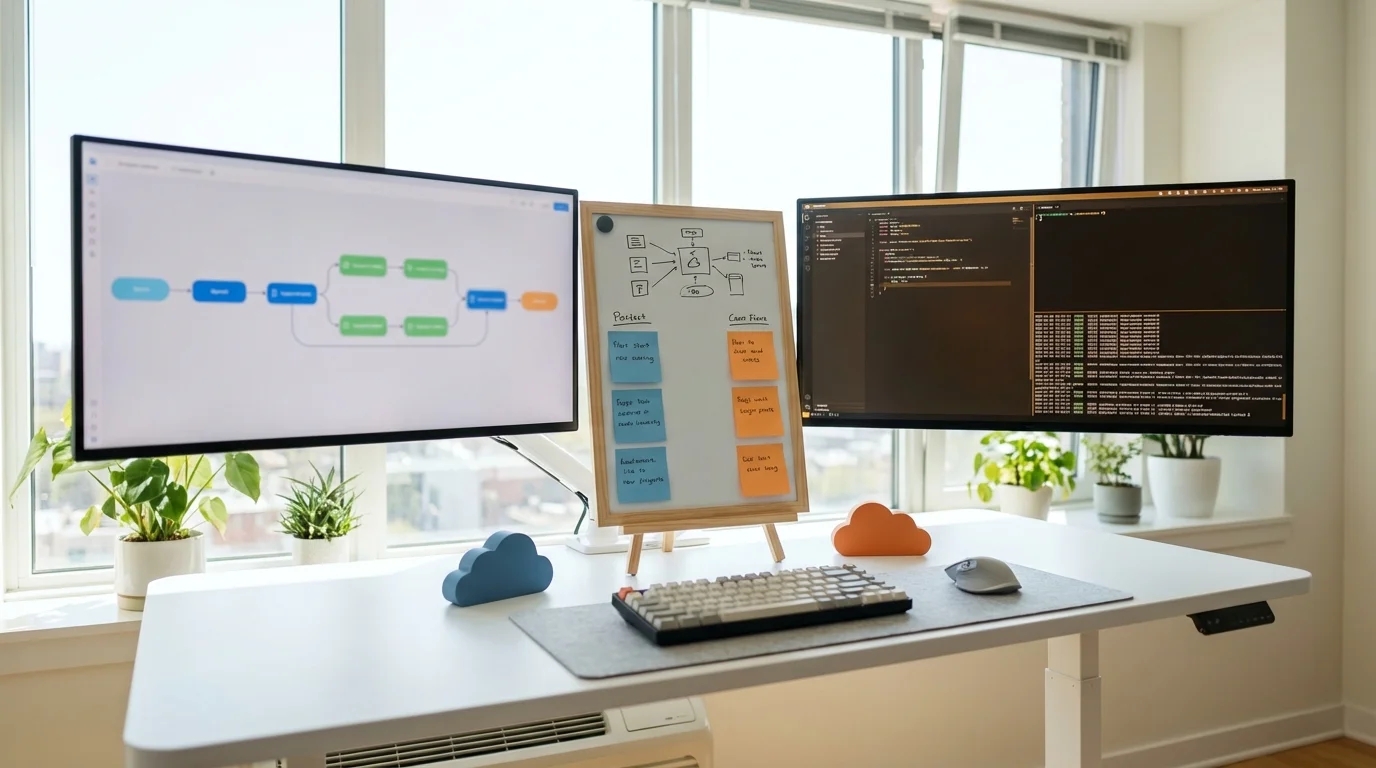
Google ADK gives you explicit orchestration with Sequential, Parallel, and Loop agents, plus a built-in web debugger that makes reasoning visible. AWS Strands takes a model-driven approach where the LLM decides orchestration dynamically, with Lambda deployment in seconds and 5-second cold starts. Pick ADK for complex, auditable multi-agent workflows on GCP. Pick Strands for fast serverless deployment on AWS. Both support MCP natively and can interoperate on Bedrock AgentCore.
Speed versus control is the defining tension between Google ADK and AWS Strands Agents in 2026. Picture a logistics multi-agent system that coordinates route optimization, real-time weather adjustments, and driver dispatch with full auditability for an operations team. On AWS Strands, the model-driven approach gets you to a working demo in a day, but ask "which agent made which decision and why?" and you can't answer it cleanly without building custom tracing from scratch. Rebuild the orchestration layer on Google ADK and every execution path is explicit in the graph definition; the operations team can finally trace decisions end to end.
That trade-off shows up in nearly every production agent system this year. Both are production-grade, open-source, MCP-native agent frameworks backed by cloud giants. But they embody fundamentally different philosophies about how agents should be orchestrated, and choosing wrong costs you weeks of rework. For a broader view of the agent framework landscape including LangGraph and CrewAI, see our comparison of major agent frameworks in 2026. For the Azure-centric counterpart that landed April 3, 2026, see our Microsoft Agent Framework 1.0 vs Google ADK vs smolagents head-to-head.
Why This Is the Enterprise Agent Platform Decision of 2026
The agent framework landscape consolidated fast. In 2025, teams debated LangChain versus raw API calls. In 2026, the conversation shifted to cloud-native agent platforms where the framework and the infrastructure are designed to work together. Google and AWS each released opinionated frameworks that integrate deeply with their respective cloud ecosystems, and that's what makes this decision different from picking a Python library. Both ADK and Strands still assume you write code, so if your team would rather assemble an agent without engineering, our comparison of no-code CRM-native agent platforms weighs Agentforce, Copilot Studio, and Vertex Agent Builder by where your data already lives.
Choosing Google ADK means your agents deploy naturally to Vertex AI and Cloud Run, use Gemini models with first-class support, and benefit from Google's A2A protocol for agent interoperability. Choosing AWS Strands means your agents deploy to Lambda and Bedrock AgentCore, access models through Amazon Bedrock, and integrate with the AWS service ecosystem your infrastructure team already knows.
This isn't just a framework comparison, it's a cloud platform bet. And both platforms reached production maturity almost simultaneously in early 2026, which is why teams that delayed this decision are now scrambling to catch up. If you're building multi-agent systems, our guide on orchestration patterns that actually work covers the architectural foundations both platforms build on.
Google ADK Deep-Dive: Explicit Orchestration with Full Visibility
Google's Agent Development Kit takes a code-first, graph-based approach to agent orchestration. You define exactly how agents coordinate using three workflow primitives: SequentialAgent, ParallelAgent, and LoopAgent. There's no magic, every execution path is visible in your code.
from google.adk.agents import SequentialAgent, ParallelAgent, LoopAgent

# Pipeline: classify → enrich → decide
pipeline = SequentialAgent(
    name="order_pipeline",
    sub_agents=[classify_agent, enrich_agent, decision_agent]
)

# Fetch multiple data sources simultaneously
data_gather = ParallelAgent(
    name="gather_context",
    sub_agents=[pricing_agent, inventory_agent, shipping_agent]
)

# Retry with refinement until quality threshold met
refine_loop = LoopAgent(
    name="quality_loop",
    sub_agents=[draft_agent, review_agent],
    max_iterations=3
)
Sequential, Parallel, and Loop Agents
ADK's workflow agents are composable building blocks that handle the three patterns covering 90% of real-world orchestration needs: The SequentialAgent runs sub-agents in strict order, each agent's output feeds the next through shared session state. The ParallelAgent runs sub-agents concurrently, though you need to ensure each writes to a unique state key to avoid race conditions. The LoopAgent repeats its sub-agents until either max_iterations is reached or a sub-agent signals escalation. What makes this powerful is composability. You can nest a ParallelAgent inside a SequentialAgent inside a LoopAgent. The orchestration logic is explicit in your code, not hidden in prompt engineering or framework internals. When a compliance officer asks "can this agent ever skip the validation step?", you point to the graph and answer definitively.
Built-In Web Debugger
ADK's killer feature for development is its local debugging interface. Run adk web and you get a browser-based UI that shows agent reasoning, tool calls, state mutations, and execution paths in real time. You can step through agent decisions, inspect intermediate states, and understand exactly why an agent took a specific action. This matters more than it sounds. In our experience building agents at Particula Tech, 60% of development time goes to debugging agent behavior, understanding why the agent chose tool A over tool B, or why it entered a reasoning loop. ADK's debugger compresses that cycle from hours to minutes.
TypeScript Support and Model Flexibility
ADK launched TypeScript support with a dedicated adk-js package, bringing the same agent primitives to the JavaScript ecosystem. The TypeScript SDK includes full type safety, the same Sequential/Parallel/Loop workflow agents, and idiomatic async/await patterns. While ADK is optimized for Gemini, and the integration is noticeably smoother with Gemini 3 Pro and Flash, it's model-agnostic by design. You can plug in Anthropic Claude, open-source models via Ollama, or any provider with a compatible API. The trade-off is that non-Gemini models may require additional configuration for tool-calling formats and streaming behavior. With approximately 18.7K GitHub stars on the Python SDK and active development toward v2.0, ADK has momentum. Google Cloud's managed MCP servers and A2A protocol support create an ecosystem that's hard to replicate outside GCP.
AWS Strands Deep-Dive: Model-Driven Autonomy
AWS Strands takes the opposite approach. Instead of defining explicit workflows, you give the agent a system prompt, a set of tools, and let the foundation model decide how to orchestrate steps. It's agent development reduced to three components: model, prompt, tools.
from strands import Agent
from strands.models.bedrock import BedrockModel

model = BedrockModel(model_id="anthropic.claude-sonnet-4-20250514")

agent = Agent(
    model=model,
    system_prompt="""You are a logistics coordinator.
    Use available tools to optimize delivery routes,
    check weather conditions, and coordinate with drivers.""",
    tools=[route_optimizer, weather_check, driver_dispatch]
)

response = agent("Optimize today's delivery schedule for the Portland region")
The Model-Driven Architecture
That's a functional agent in eight lines of code. No graph definition, no workflow primitives, no orchestration boilerplate. The model examines the tools available, reasons about which ones to call and in what order, and executes autonomously. This simplicity is Strands' superpower for a specific class of problems: tasks where you trust the model's judgment and don't need deterministic execution paths. For exploratory agents, research assistants, and internal tools where "good enough" routing is acceptable, Strands gets you to production remarkably fast. The trade-off is that you lose visibility into why the agent chose a particular execution path. The model's reasoning is opaque unless you explicitly instrument tracing. When a stakeholder asks "why did the agent skip the weather check?", the answer is "the model decided it wasn't necessary," which may not satisfy regulated industries.
Lambda Deployment in Seconds
Where Strands truly shines is deployment. AWS built it to integrate seamlessly with Lambda, and the results are dramatic: Compare this to ADK's Cloud Run deployment, which requires a FastAPI backend and sees cold starts of 50 seconds to a minute with standard memory allocation. For workloads with unpredictable traffic patterns, customer support agents, on-demand analysis tools, event-driven processing, Strands' Lambda integration is a clear advantage.
- Cold start: ~5 seconds on Lambda with the official Strands layer
- Deployment: Seconds using the pre-built Lambda layer, no container builds, no FastAPI wrapper
- Cost model: Pay-per-invocation, zero cost at idle
- Scaling: Lambda's automatic scaling handles burst traffic without configuration
Strands Labs and the AWS Ecosystem
AWS launched Strands Labs in early 2026 as an experimental GitHub organization for pushing agent capabilities forward. Projects include robotics integration, simulation environments, and AI function generation, signaling that AWS sees Strands as a long-term platform, not a one-off SDK. More importantly, Strands already powers production AWS services: Amazon Q Developer, AWS Glue, and VPC Reachability Analyzer all run on Strands internally. With over 14 million downloads, this isn't a experimental framework, it's battle-tested infrastructure. The community has contributed model providers for Cohere, xAI, Fireworks AI, NVIDIA NIM, vLLM, and SGLang, making Strands surprisingly model-diverse despite its AWS origins. You're not locked into Bedrock models, though that's where the integration is smoothest.
Architecture Comparison: Explicit Orchestration vs Model-Driven Autonomy
This is the fundamental architectural decision, and getting it wrong shapes everything downstream.
When Explicit Orchestration Wins
ADK's explicit approach dominates when you need: Consider a healthcare workflow where agents must always, without exception, check drug interactions before recommending dosage adjustments. ADK's SequentialAgent enforces that ordering structurally. No prompt engineering can guarantee a model won't skip a step under unusual input conditions. For more on safely building agents with these kinds of guardrails, see our guide on building complex AI agents.
- Compliance and auditability: Regulated industries where you must prove an agent followed specific steps
- Complex branching logic: Workflows with conditional paths, rollback points, and human-in-the-loop gates
- Deterministic behavior: The same input must produce the same execution path every time
- Multi-agent coordination: Intricate handoffs between specialized agents where timing and ordering matter
When Model-Driven Autonomy Wins
Strands' model-driven approach dominates when you need: A typical internal tool, an agent that searches documentation, checks ticket history, and drafts responses for support engineers, is a perfect fit for Strands. The tool selection is straightforward, the ordering doesn't matter much, and Lambda deployment means zero cost during off-hours.
- Rapid prototyping: Getting a working agent in front of stakeholders within hours
- Exploratory tasks: Agents that need to adapt their approach based on what they discover
- Simple tool orchestration: Agents with 3-5 tools where the ordering is straightforward
- Cost-sensitive deployment: Pay-per-invocation Lambda pricing for unpredictable workloads
| Aspect | Google ADK | AWS Strands |
|---|---|---|
| Orchestration | Explicit (Sequential/Parallel/Loop) | Model-driven (LLM decides) |
| Control flow | Deterministic, auditable | Dynamic, model-dependent |
| Boilerplate | Higher (graph definitions) | Minimal (3 components) |
| Debugging | Visual web debugger | Programmatic instrumentation |
| Predictability | High, every path is defined | Lower, model may vary |
| Flexibility | You define the boundaries | Model adapts dynamically |
| Learning curve | Moderate (workflow primitives) | Low (prompt + tools) |
Head-to-Head: MCP, Deployment, Debugging, and Pricing
For teams already on AWS, Strands' deployment story is compelling. Lambda's pay-per-invocation model and near-instant deployment remove operational friction that slows down iteration. For teams on GCP, ADK's Vertex AI integration provides managed infrastructure that handles model serving, evaluation, and monitoring in one platform.
MCP Support
Both frameworks achieved native MCP support in early 2026, but the integration patterns differ: Google ADK treats MCP servers as tool providers. You configure an MCP server connection, and all tools from that server become available to your agents. With Google Cloud launching managed MCP servers, you can access first-party Google service integrations without running your own MCP infrastructure. AWS Strands also supports any published MCP server as agent tools. The key difference is Lambda lifecycle management, you need to establish a new MCP connection per Lambda invocation since connections don't persist across cold starts. This adds slight latency but ensures clean state. Both frameworks can access the 13,000+ community-built MCP servers, so the tool ecosystem is equivalent. The difference is operational: ADK's long-running processes maintain persistent MCP connections, while Strands' serverless model requires per-invocation setup.
Deployment and Infrastructure
Debugging and Observability
This is where ADK has a clear lead. The adk web command gives you a visual debugging interface that shows: Strands requires you to build this observability yourself. You can integrate with AWS X-Ray, CloudWatch, or OpenTelemetry, but there's no out-of-the-box visual debugger. For teams new to agent development, this gap is significant, we've seen it add days to debugging cycles. Strands does offer structured logging and event hooks that experienced teams can leverage for sophisticated monitoring. And Bedrock AgentCore provides additional observability for production deployments. But the out-of-the-box experience favors ADK.
- Real-time agent reasoning and decision points
- Tool call inputs, outputs, and latency
- State mutations across the agent graph
- Execution path visualization
Pricing Considerations
Both frameworks are open-source and free. The costs come from infrastructure and model usage: Google ADK costs: Gemini API pricing (Gemini 3 Flash is notably inexpensive), Cloud Run compute, Vertex AI platform fees for managed features. AWS Strands costs: Bedrock model pricing (per-token for Claude, Llama, Nova models), Lambda compute (per-invocation + duration), AgentCore fees for managed deployment. For high-volume, steady-state workloads, Cloud Run's minimum instance pricing can be more predictable. For bursty or low-volume workloads, Lambda's pay-per-invocation model wins on cost. The model pricing depends on which LLM you choose, Gemini Flash and Amazon Nova are the budget options on each platform.
| Deployment Aspect | Google ADK | AWS Strands |
|---|---|---|
| Primary target | Vertex AI / Cloud Run | Lambda / Bedrock AgentCore |
| Cold start | 50s–1min (Cloud Run) | ~5s (Lambda) |
| Scaling | Cloud Run auto-scaling | Lambda auto-scaling |
| Container required | Yes (FastAPI wrapper) | No (Lambda layer) |
| Deploy time | Minutes | Seconds |
| Idle cost | Cloud Run minimum instances | Zero (Lambda) |
Cross-Platform Interoperability on Bedrock AgentCore
One of the most significant developments of early 2026 is that these platforms don't have to be mutually exclusive. AWS demonstrated cross-platform agent coordination on Bedrock AgentCore Runtime, where a Google ADK orchestrator directed Strands and OpenAI SDK agents, all running on the same infrastructure.
AgentCore Runtime supports agents built with any framework, ADK, Strands, LangGraph, CrewAI, OpenAI Agents SDK, using the A2A (Agent-to-Agent) protocol for communication. This means you can:
This interoperability suggests the "which platform" question may eventually become "which platform for which agent," rather than a monolithic choice. But today, most teams benefit from standardizing on one framework for consistency, debugging efficiency, and team expertise. For a deeper look at how A2A fits alongside MCP and the newer AG-UI protocol in a production agent stack, see our protocol comparison guide.
Decision Framework: Choosing by Team and Use Case
Choose Google ADK If:
- Your team is on GCP and you want native Vertex AI integration
- You're in a regulated industry where audit trails and deterministic execution paths are non-negotiable
- You're building complex multi-agent systems with conditional branching, loops, and parallel execution
- Your team is new to agent development and needs visual debugging to accelerate learning
- You need TypeScript support with the same orchestration primitives available in Python
Choose AWS Strands If:
- Your team is on AWS and you want native Lambda and Bedrock integration
- You need rapid prototyping and want working agents in hours, not days
- Your workloads are bursty or unpredictable and you need pay-per-invocation pricing
- Your agents are tool-driven with straightforward orchestration that the model can handle
- You want production validation, Strands powers Amazon Q Developer and AWS Glue internally
Choose Both (via AgentCore) If:
- You're building a multi-agent platform where different agents have different orchestration needs
- You have teams on both clouds and need framework flexibility
- You want to future-proof against framework lock-in by adopting A2A protocol standards
Team Size Considerations
Solo developers and small teams (1-5): Start with Strands. The model-driven approach gets you to a working prototype fastest, and Lambda deployment eliminates infrastructure management. Switch to ADK for specific agents that need deterministic control flow. Mid-size teams (5-20): Choose based on your cloud provider. The ecosystem integration benefits compound with team size, shared tooling, deployment pipelines, and monitoring become more valuable as more people touch the system. Enterprise teams (20+): Likely need both. ADK for compliance-critical, auditable workflows. Strands for rapid internal tools and exploratory agents. AgentCore for the coordination layer. Invest in A2A protocol adoption early.
The Bottom Line
Google ADK and AWS Strands aren't competing to solve the same problem, they're optimized for different points on the control-versus-speed spectrum. ADK gives you an explicit, auditable orchestration layer with the best debugging experience in the agent framework space. Strands gives you model-driven autonomy with the fastest path from code to production on serverless infrastructure.
The teams shipping the most effective agent systems in 2026 aren't debating which philosophy is "better." They're matching the orchestration pattern to the problem: explicit control where predictability matters, model-driven autonomy where speed matters. And with AgentCore enabling cross-framework interoperability, you don't have to make a permanent, all-or-nothing choice.
Pick the one that matches your cloud, your team's experience, and your most urgent use case. You can always add the other later.
FAQ
Quick answers to the questions this post tends to raise.