
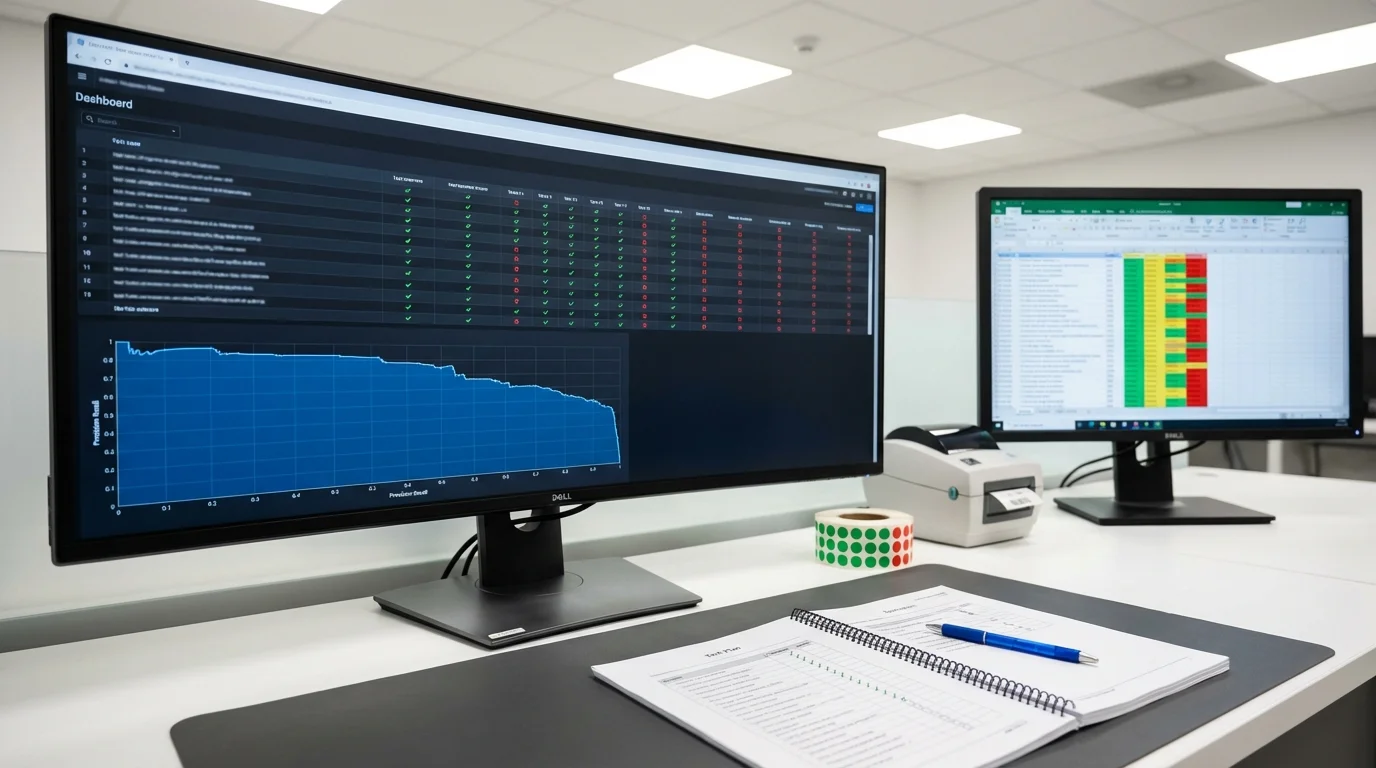
Effective RAG evaluation requires measuring three distinct components: retrieval quality (are the right chunks returned?), generation faithfulness (does the answer use retrieved context correctly?), and answer relevance (does the response actually address the query?). Start by building a ground-truth test set of 50-100 query-document pairs from real user questions. Measure retrieval with precision@k and recall@k. Evaluate generation using LLM-as-judge approaches for faithfulness and hallucination detection. Automate these checks in CI/CD to catch regressions before production. The goal isn't perfect scores, it's identifying failure patterns and systematically improving.
Most teams evaluate RAG systems by running a few queries and checking if the answers look reasonable. That's not evaluation, that's hope.
The failure pattern is predictable: a RAG system confidently tells a customer their enterprise plan includes unlimited API calls. It doesn't. The retrieval surfaced a marketing draft from a deprecated folder, and the LLM synthesized it into an authoritative-sounding response. The information was wrong, the citation was wrong, and the system had no way to flag its own uncertainty.
RAG systems that work "most of the time" in demos regularly fail in production because nobody measured what matters. Evaluation isn't optional, it's the difference between a system you can trust and one that will eventually embarrass you.
Here's how to build RAG evaluation that actually reveals whether your system works.
Why RAG Evaluation Is Different from Standard ML
Traditional machine learning evaluation is straightforward: compare predictions against ground truth labels, compute accuracy. RAG systems break this model because they have multiple failure points, each requiring different evaluation approaches.
Three components, three failure modes
Your RAG pipeline has distinct stages: retrieval (finding relevant chunks), augmentation (constructing the prompt with context), and generation (producing the response). Each can fail independently, and aggregate metrics hide where problems originate. Retrieval might return perfect chunks while generation hallucinates. Generation might be faithful to context while retrieval missed the most relevant documents. Both components might work individually but produce wrong answers because the query was ambiguous. Effective evaluation isolates these failure modes rather than collapsing them into a single score.
No universal ground truth
Unlike classification tasks with objective labels, RAG correctness is often subjective. "What's our refund policy?" might have multiple valid answers depending on customer segment, purchase type, and timing. The same retrieved chunk might support several different correct responses. Your evaluation framework must handle this ambiguity rather than forcing binary correctness judgments.
Context dependence matters
A RAG response isn't just right or wrong, it's appropriate or inappropriate given the retrieved context. An answer that's factually correct but contradicts your documentation is a failure. An answer that's technically incomplete but accurately summarizes retrieved content is often acceptable. Evaluation must assess generation relative to retrieved context, not just against some external truth.
Building Your Evaluation Dataset
Meaningful RAG evaluation starts with a test set that represents actual usage patterns. Here's how to build one that reveals real performance.
Mine production queries
The best evaluation queries come from actual users. Export query logs from your existing search, support tickets, or internal questions. These reflect how people actually phrase questions, not how you imagine they will. Sample across time periods to capture query diversity and seasonal patterns. If you're building a new system without query history, conduct user interviews. Ask subject matter experts what questions they'd ask. Have stakeholders submit questions without seeing the documentation first. These reveal natural language patterns that synthetic test cases miss.
Label ground-truth documents
For each evaluation query, identify which documents or chunks should be retrieved. This manual labeling is tedious but essential, you can't measure retrieval accuracy without knowing what correct retrieval looks like. Involve domain experts in labeling. They understand which documents actually answer questions, not just which ones contain keyword matches. Document labeling criteria so annotations remain consistent as you add test cases. For a 100-query evaluation set, budget 4-8 hours of expert time for comprehensive labeling. This investment pays off through every subsequent evaluation cycle.
Include adversarial cases
Add queries designed to expose failure modes: questions where multiple documents contain relevant information, queries with ambiguous phrasing, questions about information not in your corpus, and queries that could retrieve outdated or contradictory content. These adversarial cases reveal system behavior at the edges. A system that handles easy queries but fails on edge cases will disappoint users who ask the hard questions, often your most important users.
Version and maintain your dataset
Your evaluation dataset is infrastructure. Version it alongside code. Document when queries were added and why. Review annotations periodically for consistency. As your document corpus changes, verify that ground-truth labels remain valid. One common mistake: creating an evaluation set once and never updating it. Your users' questions evolve. Your documentation changes. Static evaluation sets become less representative over time. Plan for quarterly reviews and ongoing expansion based on production failures.
Measuring Retrieval Quality
Retrieval evaluation asks: does your vector search return the right chunks? Without accurate retrieval, generation can't succeed.
Precision and recall at k
Precision@k measures what percentage of retrieved chunks are relevant. If you retrieve 5 chunks and 3 contain useful information, precision@5 is 60%. Higher precision means less noise in your context window. Recall@k measures what percentage of all relevant chunks you retrieved. If your corpus contains 4 relevant documents for a query and you retrieved 3 of them in your top 10, recall@10 is 75%. Higher recall means you're not missing important information. For most RAG systems, track precision@5 and recall@10. These capture the chunks that actually end up in your prompt context and whether you're missing critical information. Aim for precision above 70% and recall above 60% as initial targets, then improve based on failure analysis. Recall matters most once your corpus spans multiple systems: on a 39,190-artifact enterprise pool, the best agentic RAG method scored just 32.96 out of 100, and retrieval was the bottleneck rather than the model.
Mean Reciprocal Rank
MRR measures how early the first relevant result appears. If the most relevant chunk is position 1, MRR is 1.0. If it's position 3, MRR is 0.33. Higher MRR means users (and your LLM) see the most important information first. MRR matters because context window position affects generation. LLMs weight earlier context more heavily. If your best chunk appears last among retrieved results, the model might ignore it in favor of earlier, less relevant chunks. If ordering is your weak spot, benchmark rerankers on your own corpus with NDCG@10 and Hit@1 to see whether a reranking pass moves the right chunk to the top.
Embedding similarity distribution
Beyond binary relevance, examine the similarity score distribution for retrieved chunks. Healthy retrieval shows clear separation: relevant chunks have high similarity scores, irrelevant chunks have low scores. Problematic retrieval shows flat distributions where relevant and irrelevant chunks score similarly. Plot similarity histograms for your evaluation queries. Large overlap between relevant and irrelevant chunk scores indicates your embedding model struggles with your content. Consider evaluating different embedding models or fine-tuning for your domain.
Failure pattern analysis
Aggregate metrics hide important patterns. After computing overall scores, analyze which queries fail. Do failures cluster around specific topics? Query types? Document categories? Time periods? A common failure mode in RAG deployments we've audited: the system performs fine on aggregate metrics but breaks consistently on a specific query class, say, product-comparison questions where retrieval returns chunks from individual product pages but misses comparison documentation in a different folder. The fix is usually simple, improve document coverage, but aggregate metrics never surface the pattern. Only systematic failure analysis does. Before you blame the retriever, check the ingestion path too, because many retrieval failures trace back to bad PDF parsing, not the retriever, where tables and multi-column layouts get mangled into unsearchable text.
Evaluating Generation Quality
Even with perfect retrieval, generation can fail. These metrics assess whether your LLM produces faithful, relevant responses.
Given this context: [retrieved chunks] And this response: [generated answer] For each factual claim in the response, is it directly supported by the context? List each claim and whether it's supported, partially supported, or unsupported.
Given this query: [user question] And this response: [generated answer] Does the response address what the user was asking? Rate as: fully addresses, partially addresses, or does not address.
Faithfulness to context
Faithfulness measures whether the generated response is supported by retrieved chunks. A faithful response only claims things that appear in the context. An unfaithful response adds information, makes unsupported claims, or contradicts the retrieved content. Implement faithfulness evaluation using an LLM-as-judge approach. Prompt a separate model (or the same model with a different system prompt) to verify each claim in the response against the retrieved context. Flag responses containing unsupported statements. Structure the evaluation prompt to output binary judgments with explanations: Track faithfulness rate across your evaluation set. Production systems should target 95%+ faithfulness. Anything below 90% indicates systematic generation problems.
Hallucination detection
Hallucinations are a specific faithfulness failure: the model invents information that sounds plausible but isn't in the context. These are particularly dangerous because they're hard for users to detect. Beyond general faithfulness checks, implement specific hallucination detection. Look for: For guidance on structuring prompts to reduce hallucinations, see our article on system prompts versus user prompts.
- Named entities not present in context (people, products, dates, numbers)
- Specific claims with quantitative details not in retrieved chunks
- References to documents or sections not actually retrieved
Answer relevance
Relevance measures whether the response actually addresses the user's query. A faithful response that doesn't answer the question is still a failure. Evaluate relevance by prompting a judge model to assess whether the response addresses the query intent: Low relevance with high faithfulness usually indicates retrieval problems, the system found content and summarized it faithfully, but it wasn't the content the user needed.
Response completeness
For complex queries, assess whether responses cover all aspects of the question. A user asking "What are the pricing tiers and what features does each include?" expects information about multiple tiers, not just one. Decompose complex queries into sub-questions during evaluation. Check whether the response addresses each component. Incomplete responses often indicate retrieval gaps, some relevant chunks weren't returned, or context window limitations where important information was truncated.
Automated Evaluation in CI/CD
Manual evaluation doesn't scale. Integrate automated checks into your deployment pipeline to catch regressions before production.
Threshold-based gating
Define minimum acceptable scores for deployment. If precision@5 drops below 65% or faithfulness falls under 90%, block the deployment for review. These thresholds prevent gradual degradation from reaching users. Start with conservative thresholds that allow deployment but trigger alerts. Tighten thresholds as you build confidence in your evaluation metrics. The goal is catching real problems without blocking legitimate changes.
Regression detection
Compare current evaluation scores against baseline from your last stable deployment. Flag any metric that drops more than 5% from baseline, even if it remains above absolute thresholds. Regressions often indicate unintended consequences from changes. Track metrics over time in a dashboard. Gradual degradation, 1% drop per deployment, compounds into significant problems that threshold checks miss. Trend visualization reveals slow decline before it becomes critical.
Test set stratification
Run evaluation separately for different query categories, document types, and user segments. A change might improve overall metrics while degrading performance for an important subset. Stratified evaluation reveals these hidden tradeoffs. If your system serves multiple use cases, maintain separate evaluation sets for each. A universal evaluation set might weight low-value queries equally with high-value ones, masking problems that matter most to your business.
Production Monitoring and Continuous Improvement
Evaluation doesn't end at deployment. Production monitoring reveals failures that evaluation datasets miss.
Sample-based quality checks
You can't manually review every production response. Sample 1-5% of queries for human evaluation. Use stratified sampling to cover diverse query types, not just random selection. Have reviewers rate responses on relevance, accuracy, and helpfulness. Track these scores over time. Divergence between automated metrics and human ratings indicates your evaluation framework needs calibration.
User feedback integration
Direct user signals, thumbs up/down, explicit corrections, follow-up questions, provide ground truth about real-world quality. Build feedback mechanisms into your interface and route negative signals to evaluation review. When users flag incorrect responses, add those queries to your evaluation set with correct ground truth. This creates a feedback loop where production failures improve future evaluation coverage.
Failure investigation workflow
Establish a process for investigating quality issues. When metrics drop or users report problems, trace the failure through your pipeline. Was retrieval wrong? Was context appropriate but generation failed? Was the query ambiguous? Document failure investigations and their resolutions. Patterns emerge across investigations, common document types that cause problems, query phrasings that confuse retrieval, generation failure modes on specific topics. These patterns guide systematic improvements. For production debugging approaches, see our guide on tracing AI failures in production. If your failure analysis reveals that fixed retrieval pipelines consistently miss relevant context, consider agentic RAG architectures where an agent controls retrieval dynamically, these systems can self-correct by reformulating queries and validating results before generating a response.
Building Evaluation Into Your RAG Practice
RAG evaluation isn't a one-time project. It's an ongoing practice that improves system quality over time.
Start with a minimal evaluation set, 50 queries with ground-truth labels. Implement retrieval metrics (precision@5, recall@10) and basic faithfulness checking. Run these on every change. This baseline catches obvious problems without major investment. When you outgrow hand-rolled metrics, our guide to choosing a RAG evaluation framework like DeepEval, RAGAS, or TruLens compares metric coverage, CI/CD fit, and production thresholds across the main options.
Expand evaluation as you learn. Add queries from production failures. Include adversarial cases that expose edge conditions. Implement more sophisticated generation evaluation as you understand your system's failure modes.
The goal isn't perfect scores on arbitrary metrics. It's building confidence that your RAG system does what users expect. Good evaluation reveals specific failure patterns you can address, not just abstract numbers that go up or down.
Teams that evaluate rigorously ship better systems. They catch problems before users do. They make targeted improvements instead of guessing. They build trust in AI capabilities rather than hoping for the best.
Your RAG system is either getting evaluated by your metrics or by your users' frustration. Choose metrics.
FAQ
Quick answers to the questions this post tends to raise.