Latency dashboards tell you your AI system is responding, not that it's responding well. Monitor three dimensions most teams miss. Quality drift: run automated evals on 5-10% of production outputs daily and alert on 5%+ score drops against your baseline. Hallucination detection: implement grounding verification that cross-references outputs against source documents, flag unsupported claims, and track hallucination rates over time. Cost monitoring: track cost per query segmented by model and use case, alert on P95 spikes, and watch for token count inflation from context window bloat. Build layered alerts, not just 'is the API up?' but 'are outputs still accurate, grounded, and cost-efficient?' Teams running reliable production AI treat output quality as a first-class metric alongside latency and uptime.
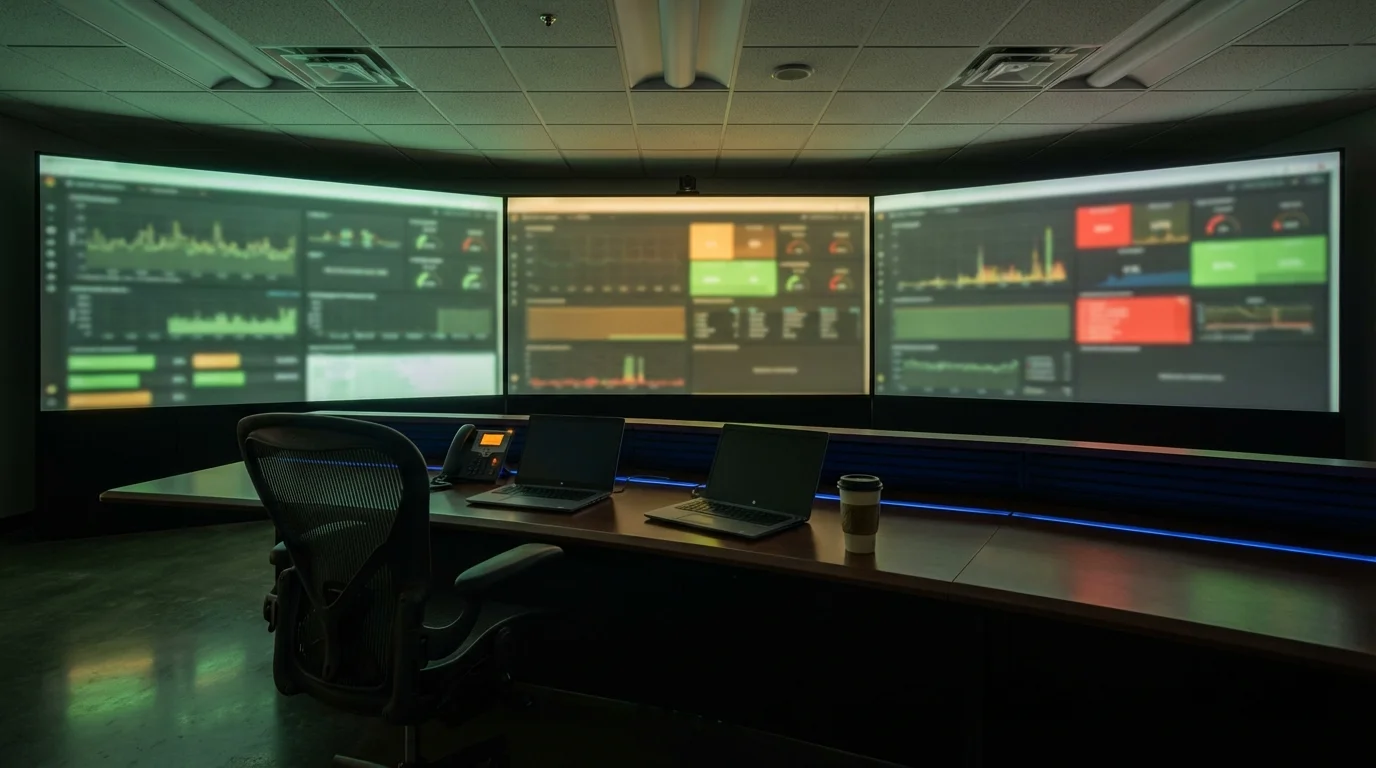
Your latency dashboard is green. P95 under 800 milliseconds. Uptime at 99.97%. By every metric your monitoring stack reports, your AI system is healthy.
Except your customer success team is fielding more complaints about "weird answers" than they did two months ago. Finance noticed AI API spend jumped 35% without a corresponding increase in usage. A support agent screenshot shows your chatbot confidently citing a product feature that doesn't exist.
The system is fast. The system is up. The system is degrading.
At Particula, we see this pattern across production AI deployments regularly. Teams invest in infrastructure monitoring, the same observability practices they'd apply to any backend service, and assume that covers AI. It doesn't. AI systems fail in ways traditional monitoring can't detect: output quality degrades silently, hallucination rates creep upward, and costs spike from invisible inefficiencies.
This article covers the three production AI failures that latency dashboards miss entirely, and the monitoring approaches that catch them before users notice.
The False Confidence of Green Dashboards
Standard application monitoring answers one question: is the system responding? For traditional software, that's most of what matters. A REST API either returns the correct data or throws an error. A database query either completes or times out. The output is deterministic, and "responding" is a reasonable proxy for "working."
AI systems break this assumption fundamentally. A language model can return a 200 status code, respond in 400 milliseconds, and produce output that is factually wrong, off-topic, or twice as expensive as it should be. None of these failures register on infrastructure dashboards.
This gap creates organizational blindness. Engineering sees green dashboards and assumes health. Product teams hear complaints and assume users are being picky. The actual degradation sits in no one's monitoring because no one measures output quality as a first-class metric.
The three failure modes that fall through this gap, quality drift, hallucination increases, and cost anomalies, share a trait: they compound gradually. A 2% quality drop per week is invisible on any given day and catastrophic over a quarter. A hallucination rate that climbs from 3% to 8% over two months triggers no alert. A per-query cost increase of $0.002 adds up to thousands monthly at scale. These aren't edge cases. They're the default failure mode of unmonitored production AI.
Quality Drift: Outputs Degrade Without Any Changes on Your End
Quality drift is the gradual degradation of AI output quality over time, even when you haven't changed anything in your system. It's the most insidious production failure because the absence of a deployment event makes it invisible to change-tracking workflows.
What causes it
The most common trigger is upstream model updates. When OpenAI, Anthropic, or Google updates a model version, sometimes with minimal documentation, your carefully tuned prompts may behave differently. A prompt that reliably extracted structured data from invoices might start missing fields or formatting outputs differently after a provider update. You didn't change your code. Your tests still pass against hardcoded fixtures. But production quality dropped. User behavior shifts cause drift too. A customer support chatbot optimized for questions about Product A starts receiving questions about Product B after a launch. The system wasn't evaluated against these queries, and quality on the new distribution is meaningfully lower. Seasonal patterns compound this, tax season, holiday shopping, enrollment periods all shift the input distribution your AI encounters.
How to detect it
Detection requires continuous evaluation on production traffic. Sample 5-10% of live outputs and score them automatically using the same rubric-based approach you'd use in evals-driven development. Track scores daily across each quality dimension, accuracy, relevance, completeness, tone. The key metric is score trend over time, not absolute score on any given day. Establish a rolling baseline from your first two weeks of monitoring. Alert when any dimension drops more than 5% from baseline over a 7-day rolling window. This catches gradual degradation that day-to-day spot-checking misses entirely. For RAG systems, separate retrieval quality from generation quality in your drift monitoring. Retrieval might degrade because your knowledge base is stale while generation remains strong, or the reverse. Aggregating them into a single score hides the root cause and delays the fix.
Hallucination Detection at Production Scale
Hallucinations, outputs that sound confident but contain fabricated information, are dangerous precisely because they look identical to correct responses. Users can't distinguish a hallucinated answer from an accurate one without independent verification, and most users won't verify.
Why hallucination rates spike
Hallucination rates aren't static. They fluctuate based on query complexity, retrieval context quality, and model behavior. A RAG system that hallucinated on 2% of queries during testing might reach 8% when users ask questions outside the knowledge base's coverage. Model provider updates can shift hallucination patterns without warning. Even generation parameters that worked well for one query distribution can increase confabulation when the distribution shifts.
Practical detection approaches
Grounding verification checks whether claims in the output are supported by the source material. For RAG systems, compare each factual claim in the response against retrieved documents. Claims that can't be traced back to a source get flagged. This can be automated using an LLM-as-judge prompt specifically designed to evaluate faithfulness, distinct from the generation model to avoid self-reinforcing errors. Consistency checking generates multiple responses to the same query and measures agreement. Factual queries should produce consistent answers across runs. High variance on factual questions signals unreliable generation, a strong hallucination indicator that grounding verification alone can miss. For the full measurement stack behind this, consistency@10, p95 task success, and the four reliability dimensions, see our breakdown of why agent reliability lags accuracy 7x in production. Confidence calibration monitors the relationship between model confidence signals and actual accuracy. When models become overconfident on incorrect outputs, high token probabilities on hallucinated content, it indicates calibration drift that correlates with increased hallucination rates. In production, running all three checks on every output isn't practical. Sample strategically: aim for 100% coverage on high-stakes queries (financial, medical, legal), 10-20% sampling on standard traffic, and targeted full verification on any query type where hallucination rates have spiked historically. Flag suspicious outputs for human review rather than blocking automatically, false positive rates on hallucination detection are still too high for fully automated blocking in most applications.
Cost Spikes That Compound Before You Notice
AI infrastructure costs don't behave like traditional compute costs. A server at capacity costs the same every hour. A language model API charges per token, and token consumption can spike dramatically without any change in request volume.
Token inflation
The most common cost spike comes from gradual increases in token consumption per query. Conversation systems that include growing message histories send more context tokens with every turn. RAG systems that retrieve too many chunks inflate input tokens. Prompts that accumulate instructions over iterative edits get longer without anyone tracking the growth. A per-query increase of 500 input tokens at current flagship pricing adds roughly $0.001 per request. At 100,000 daily requests, that's $100 per day, $3,000 per month from a change nobody intentionally made.
Retry storms
Transient API errors trigger retry logic. Without proper exponential backoff and circuit breaking, a brief provider outage generates 3-5x normal request volume. Each retry costs the same as the original request. A 10-minute outage with aggressive retries can burn through a full day's budget.
Model routing failures
Systems that route between models based on complexity, a standard pattern for latency optimization, can experience routing drift. If the complexity classifier starts sending more queries to expensive flagship models due to input distribution changes or classifier degradation, costs increase without a corresponding quality improvement. The routing logic that saved money last quarter may be leaking budget this quarter.
What to monitor
Track cost per query, not just total spend. Segment by model, endpoint, and use case. Alert on per-query P95 cost exceeding 2x your baseline. Monitor input and output token counts separately, input bloat is gradual and usually indicates a context management problem, while output token spikes often point to prompt regressions causing verbose responses. When an alert does fire, the first step is diagnosing a sudden LLM cost spike with the prompt vs completion token split to localize which side of the bill moved.
Building Alerts That Catch AI Failures Before Users Do
Traditional alerting, error rates above 1%, latency above 2 seconds, misses every failure mode discussed in this article. AI-specific alerting requires metrics that measure output quality and cost efficiency, not just availability.
Quality-based alerts
Set up automated scoring on sampled production outputs and alert on:
- Score drop: Any quality dimension falling 5%+ below baseline over a 7-day rolling window
- Hallucination rate increase: Flagged hallucination rate exceeding 2x historical baseline
- Consistency degradation: Inter-run agreement on factual queries dropping below your threshold
- Distribution shift: Input query patterns diverging significantly from your eval dataset
Cost-based alerts
- Per-query cost spike: P95 cost exceeding 2x the trailing 30-day baseline
- Token count inflation: Average input tokens per query increasing more than 15% week-over-week
- Retry rate: Failed requests exceeding 5% of total volume
- Model routing imbalance: Flagship model usage exceeding expected percentage by more than 10 points
Composite health scoring
Combine quality, cost, and latency into a weighted health score. A system that's fast and cheap but hallucinating is not healthy. A system that's accurate but costing 3x budget is not sustainable. The composite score gives your team a single metric to watch while preserving dimensional breakdowns for investigation when it drops. Build this into your existing observability stack. Datadog, Grafana, and custom dashboards all support custom metrics. The evaluation data pipeline is the hard part, once you're generating quality and cost signals, routing them into alerting infrastructure is straightforward. For LLM-specific tracing platforms that pair well with these monitoring patterns, see our Helicone vs Langfuse vs LangSmith decision guide.
From Monitoring to Continuous Improvement
Monitoring surfaces problems. The compounding value comes from feeding monitoring data back into your development process.
Quality drift detection should trigger eval suite updates. When production monitoring flags a quality drop on a specific query type, those queries become new eval cases. Your eval suite evolves to cover the failure modes your production system actually encounters, not the ones you anticipated at launch.
Hallucination patterns inform retrieval improvements. If grounding verification consistently flags certain topic areas, your knowledge base has coverage gaps in those areas. Monitoring data tells you exactly where to invest in better retrieval rather than guessing.
Cost monitoring drives architecture decisions. When per-query cost data shows that 60% of spend goes to a single use case that could run on a smaller, specialized model, you have the evidence to justify the migration. Without per-query cost attribution, these optimization opportunities remain invisible.
The monitoring stack also builds institutional knowledge. Six months of quality metrics, hallucination rates, and cost data gives your team empirical understanding of system behavior. You stop guessing whether a provider update will cause regressions and start predicting based on historical patterns. You move from reactive firefighting to proactive system management.
This is the difference between running AI in production and running it well. The first requires deployment infrastructure. The second requires the discipline to measure output quality with the same rigor you measure uptime.
Making Production AI Reliable
Latency and uptime are table stakes. They tell you your AI system is running, not that it's producing good results. The production failures that erode user trust and inflate costs happen silently, in dimensions traditional monitoring doesn't cover.
Start with three additions to your monitoring stack: automated quality scoring on sampled production outputs, hallucination rate tracking with grounding verification, and per-query cost attribution by model and use case. These three metrics close the gap between "the system is responding" and "the system is responding well."
Your users won't articulate that their experience is degrading, they'll just leave. Your budget won't warn you that costs are compounding, the invoice just arrives. Build the monitoring that catches these failures before the consequences become visible. The teams shipping reliable AI aren't the ones with the best models. They're the ones that know when their models stop performing.
FAQ
Quick answers to the questions this post tends to raise.