
An AI vendor due diligence questionnaire should fork by where the model runs: a hosted API, a model service inside your own cloud tenant, or open weights on your own hardware. Across the 17 questions in the matrix below, the two vendor-run models send 12 to a vendor and the open-weights column sends none: 13 become controls you evidence yourself and 4 do not apply. Hosted answers are conditional, not yes or no: OpenAI has not trained on API data since March 1, 2023, but keeps abuse-monitoring logs for up to 30 days by default, and zero data retention needs approval and excludes stateful features. Model lifecycle answers expire fastest: OpenAI promises at least 6 months' notice for generally available models and Anthropic at least 60 days, and OpenAI's October 14, 2026 notice retires GPT-4o and GPT-4.1 on January 14, 2027 with fine-tunes on the same schedule. Self-hosting removes the processor but adds licence, provenance, model file format and a serving stack that published 77 security advisories in 2026 through mid-October. The four-agency US third-party risk proposal of September 2026 (comments to November 16, 2026) says diligence depth should follow assessed risk, which is the case for a short form on low-risk uses. Start by adding three deployment columns to your current questionnaire and marking each question Ask, Evidence or N/A.
A flat AI vendor due diligence questionnaire sends the same questions whether the model runs on a lab's API, inside your own Azure or AWS tenant, or on GPUs in your own data centre. Ask a hosted API provider whether it retains your prompts and the honest answer comes with conditions per feature. Ask the same question about an open-weight model on your own servers and nobody on the other side can answer it, because there is no other side: the answer is your own logging configuration. The same question goes to a different party, or to nobody, depending on the deployment.
US bank regulators recently described this problem in general terms. On September 11, 2026 the OCC, the Federal Reserve, the FDIC and the NCUA proposed new third-party risk management guidance, partly because the 2023 guidance had "unintentionally incentivized overly-process-driven approaches that fail to prioritize higher-risk relationships." The proposal never mentions AI. Its logic still transfers directly to AI vendors.
Our thesis: organize the questionnaire by where the model runs, and mark every question with who supplies the evidence. The matrix below has 17 questions and three deployment models, and its open-weights column sends none of them to a vendor.
Three deployment models, three different counterparties
Before any question, establish which of three things you are buying. Each one puts a different party between your data and the model.
Hosted API. You send prompts to the model lab's own service. The lab is your processor, and retention, abuse monitoring and the model lifecycle are its decisions, set out in its terms and data-handling pages.
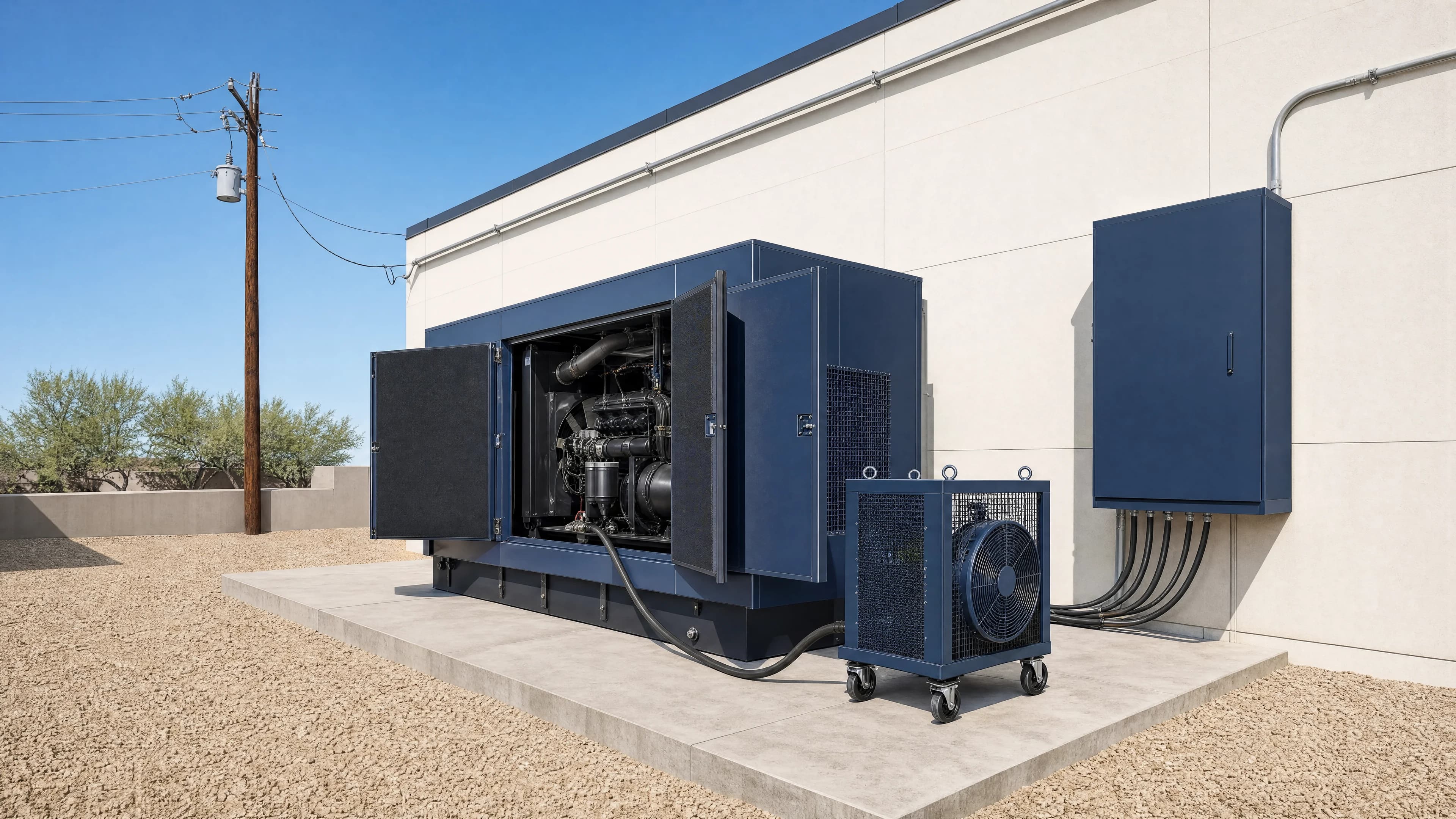
Model service in your cloud tenant. You consume the same family of models through Microsoft Foundry, which includes Azure OpenAI, or Amazon Bedrock. Microsoft's data privacy page says prompts and completions "are NOT available to OpenAI or other providers of Models sold by Azure", and Amazon's Bedrock documentation says model providers have no access to the accounts where models run, so they cannot see prompts or completions. The hyperscaler becomes your processor. Data at rest for stateful features sits in your own tenant, but processing location depends on the deployment type you choose.
Open weights on your hardware. You download weights and serve them on your own infrastructure. There is no processor. Your suppliers are now a licensor and the open-source serving software.
The cost and security trade-off between these options is its own decision, covered in cloud vs on-premise AI security and cost. This post assumes you know which one you are buying and need the right questions for it.
| Hosted API | Model service in your tenant | Open weights on your hardware | |
|---|---|---|---|
| Who processes prompts | The model lab | The hyperscaler (the lab has no access, per Microsoft and AWS docs) | You |
| Who holds stored data for stateful features | The lab, until you delete it | Your tenant, in the resource's geography (Foundry) | You |
| Who sets the model lifecycle | The lab | The hyperscaler, on its own schedule | You |
| Who you contract with | The lab | The hyperscaler | Nobody: you accept a licence |
| Main third-party exposure | Data handling and model change | Processing location and abuse-monitoring review | Licence, provenance, file safety, serving-stack patching |
The AI vendor due diligence questionnaire, as a matrix
Seventeen questions in five groups. Each cell says who answers: Ask (send it to the vendor and file the response), Evidence (the answer is your own control, so produce the evidence yourself), or N/A.
Read down the columns. The hosted API and the tenant service both send 12 questions to a vendor, answer 1 themselves and skip 4. The open-weights column sends none: 13 rows become your own evidence and 4 do not apply. Same risk topics, different counterparty.
Row 5 is deliberately one line. Parent-company jurisdiction, extraterritorial access and cross-border transfer deserve their own checklist, and that lives in our EU AI Act data sovereignty and residency guide. Here the only question is whether storage location and processing location are the same place, because the next section shows the deployment types where they differ.
Row 13 never belongs to the vendor. A vendor's published benchmark tells you about the vendor's tasks. Whether the model is fit for your claims triage or your credit memo drafting is your evidence to produce, in every column.
Capability evaluation (which model writes the best summaries, which product has the features you want) is a separate exercise. This matrix covers risk only.
| # | Question | Hosted API | Your-tenant service | Open weights |
|---|---|---|---|---|
| Data handling | ||||
| 1 | How long is each feature we will use retaining prompts, outputs and files, including abuse-monitoring logs? | Ask | Ask | Evidence |
| 2 | Are prompts, outputs or fine-tuning data used to train any model? | Ask | Ask | Evidence |
| 3 | Can humans review flagged content, who are they, where do they sit, and can review be switched off? | Ask | Ask | N/A |
| 4 | Who are the subprocessors, and does the model lab have any access to our data? | Ask | Ask | N/A |
| 5 | Where is data stored and where is it processed? (jurisdiction: see the EU residency post) | Ask | Ask | Evidence |
| Model lifecycle | ||||
| 6 | Can we pin an exact model version? | Ask | Ask | Evidence |
| 7 | What is the minimum notice before the pinned version is retired? | Ask | Ask | N/A |
| 8 | Will you tell us before anything behind a pinned version changes? | Ask | Ask | Evidence |
| 9 | If you retire the model or the contract ends, what do we keep: fine-tunes, prompts, eval sets, logs? | Ask | Ask | N/A |
| Security and incidents | ||||
| 10 | Which independent audit report covers the service, and for what period? | Ask | Ask | Evidence |
| 11 | How fast will you notify us of an incident affecting our data or the model? | Ask | Ask | Evidence |
| 12 | What adversarial testing evidence do you have for this model and service? | Ask | Ask | Evidence |
| Fitness for our use | ||||
| 13 | Does the model meet our acceptance bar on our own test set? | Evidence | Evidence | Evidence |
| Open weights only | ||||
| 14 | What do the licence terms and use restrictions require of us? | N/A | N/A | Evidence |
| 15 | Where did the files come from, and do the checksums match the publisher's? | N/A | N/A | Evidence |
| 16 | Is the model distributed in a format that cannot run code when loaded? | N/A | N/A | Evidence |
| 17 | Who watches the serving stack's security advisories, and how fast do we patch? | N/A | N/A | Evidence |
What hosted API answers look like, and why "do you retain data" is the wrong question
The binary version of each data question gets a binary answer that is technically true and practically useless. Use OpenAI's published API data controls as the worked example, because they are detailed.
Training. OpenAI states that since March 1, 2023, data sent to its API is not used to train or improve its models unless the customer opts in. That is a clean answer, and the only clean one in this group.
Retention. Abuse-monitoring logs are retained for up to 30 days by default, longer if the law requires it or if needed to protect the service or others from harm. Some response objects are stored for at least 30 days unless storage is turned off. Stateful features such as file storage, vector stores and stored conversations keep data until you delete it. Zero data retention exists, but it requires OpenAI's approval, and those stateful features are not eligible for it. So "do you retain our data?" has at least three answers depending on which features your team builds on.
Location. OpenAI offers in-region storage and processing for the US and Europe (Europe requires zero retention, modified abuse monitoring or another approved arrangement). Several other regions, including the UK, Canada, Japan and Australia, get storage residency only, with processing elsewhere.
The tenant-hosted services change the counterparty without making the questions disappear. On Microsoft Foundry, stored data for stateful features sits encrypted in your own Azure tenant, in the resource's geography. Processing is a different matter: a standard deployment processes in your chosen geography, a DataZone deployment anywhere inside the US or EU zone, and a Global deployment "in any geography where the relevant model sold by Azure is deployed." Abuse monitoring can sample prompts for review by authorized Microsoft staff unless you apply for, and are granted, modified abuse monitoring, which your Azure team can then confirm as a setting on the resource itself rather than taking it on trust. On Amazon Bedrock, retention can depend on the specific model you select, so ask per model, not per platform.
That turns rows 1, 3 and 5 into sharper questions:
For healthcare buyers, one addition: a BAA covers the features the vendor lists as eligible, not the whole product, so cross-check row 1 against that list.
Model change and deprecation: the answers that expire
Retention terms change rarely. Model versions change on a published clock, and that clock differs by vendor and channel.
OpenAI's deprecation policy gives at least 6 months' notice for generally available models, at least 3 months for specialized variants, and much shorter notice, such as 2 weeks, for previews, with a faster timeline possible for safety or compliance concerns. Anthropic commits to at least 60 days for publicly released models, and its published dates apply to Anthropic-operated platforms: the Claude API, Claude Platform on AWS, Anthropic-managed Claude models on Google Cloud, and Microsoft Foundry. Partner-operated platforms, Amazon Bedrock and Google-managed Claude models on Google Cloud, set their own retirement schedules. That is a factor of three between two major labs, and the same model can have two different end dates depending on where you buy it.
Real dates make the point. On October 1, 2026 OpenAI announced that gpt-5.1, gpt-5.4-nano and gpt-5.3-codex will be removed on April 1, 2027. On October 14, 2026 it announced removal of GPT-4o, GPT-4o mini, GPT-4.1 and GPT-4.1 mini on January 14, 2027, adding that fine-tuned versions "follow the same shutdown schedule as their underlying base models." Anthropic notified Claude Sonnet 4.5 users on September 30, 2026 of retirement on the Claude API on November 30, 2026. Any due diligence file that recorded "model: GPT-4.1, fine-tuned" in the spring now holds an answer with an end date.
A forced migration is not a config change. Prompts, tool schemas and output parsing all shift between model families, which is the cost described in migrating AI agents between model families. The control that makes it survivable is row 13: a regression set you own, re-run on every version change, as covered in LLM-as-judge regression testing for non-deterministic outputs.
The September 2026 proposal names this activity directly: its examples of ongoing monitoring include "reviews of updates to information utilized in due diligence." Row 11 matters for a second reason. The vendor's notice starts your own reporting obligations, and which regulator clock starts when an AI incident hits covers how those clocks stack.
| Answer on file | How long it stays true | Trigger to re-ask |
|---|---|---|
| Pinned model version | Until a deprecation notice: at least 6 months for OpenAI GA models, at least 60 days on Anthropic-operated platforms, set by the partner on Amazon Bedrock and Google-managed Google Cloud | Any deprecation notice for that version or its fine-tunes |
| Retention terms and zero-retention approval | Until terms change or your feature list changes | A new feature on your build list, or a vendor terms update |
| Subprocessor list | Until the vendor's next update | Vendor subprocessor notice |
| Processing location | Until the deployment type changes | A move to a Global or DataZone deployment, or a new region |
| Independent audit report | The period the report covers | Report period end |
| Incident notification terms | Until the contract changes | Contract renewal or amendment |
| Licence version (open weights) | Until you adopt a new model release | Any new model version under a new licence |
| Serving-stack version (open weights) | Until the next security advisory | Each advisory affecting your version |
When the weights run on your hardware, the questionnaire turns inward
This is where deployment model changes the answer most. With open weights on your own servers, rows 1, 2, 5, 6 and 8 are no longer promises you collect from a vendor. They are controls you operate and must evidence to an examiner or auditor: who can query the model, where prompts and outputs are logged, how long those logs are kept, who approves a model version change, and how you confirm the deployed files are the ones you approved. A regulated firm already knows how to evidence access control, logging and change management for any other internal system. The same evidence pack, applied to a model server, replaces most of the vendor form. When we build private deployments on client infrastructure, that pack is part of the delivery, because the auditor will ask for it before the model reaches production.
Rows 3, 4, 7 and 9 drop out. Nobody outside reviews your flagged prompts, no lab can see them, no one retires your model on a notice period, and you hold every file at contract end because there is no contract.
What remains, rows 14 to 17, is the supply chain.
Licence terms and use restrictions
Open weights are not the same as an open-source licence. The Llama 4 Community License incorporates an acceptable use policy, requires products built on the materials to "prominently display Built with Llama" and include a copy of the agreement, and requires any licensee whose products exceeded 700 million monthly active users in the month before the Llama 4 release date to request a licence from Meta, which Meta may grant at its sole discretion. Legal should read the licence for every model you deploy, the way they would read commercial terms. NIST AI RMF GOVERN 6.1 asks for policies covering third-party AI risk "including risks of infringement of a third party's intellectual property or other rights", which is exactly this row.
Provenance and file format
Record where the files came from, which release, and that the checksums match the publisher's. Then ask what format they are in. Model files in pickle-based formats can execute code when they are loaded; safetensors was built as a format for storing tensors safely, without that behaviour. The mechanics of vetting a checkpoint belong to our guide to picklescan bypasses and vetting model files. For the questionnaire, one line is enough: accept safetensors, and treat anything else as a security review item.
The serving stack is a supplier you patch
The software that serves the model replaces the vendor's audit report as your main operational exposure. vLLM, the open-source inference server, published 77 GitHub security advisories in 2026 through October 16 (2 critical, 17 high, 54 medium, 4 low), the latest batch of eleven on October 9, and shipped 28 releases in the same period, the most recent being v0.31.0 on October 5. That is roughly a release every ten days. Row 17 needs a named owner, a watch on the advisory feed, and a patch target per severity. What that response looks like for one real vulnerability is covered in vLLM inference server hardening for CVE-2026-22778.
Is a public licence even a third-party relationship?
The proposal says third-party relationships "typically involve written agreements", that an activity without a written agreement or clear consideration "is unlikely to constitute a third-party relationship", and it asks for comment on limiting the guidance to written agreements. Weights downloaded under a public licence sit awkwardly against that test. Do not wait for the final text: decide in your own policy whether open-weight licensors and open-source serving projects go on the third-party inventory, and record why. Either way, rows 14 to 17 still need an owner. The proposal's treatment of network access points the same direction, by analogy. It says a third party with access to systems that hold no critical data and are appropriately segmented "is not necessarily higher risk", and that such risks may be managed "primarily through safe and sound cybersecurity risk management rather than through extensive third-party risk management." That passage is about network access, not AI. The parallel is still useful: fewer outside parties touching critical data means more of the work becomes ordinary security control, which your teams already evidence every year.
Scale the depth to the risk: the US TPRM proposal and NIST GOVERN 6
The four-agency proposal was published in the Federal Register on September 15, 2026 (91 FR 58536), with comments due November 16, 2026. If finalized, it would replace the June 2023 interagency guidance on third-party relationships; until then, the 2023 guidance applies. The Federal Reserve published a separate proposed third-party risk management guide for traditional community banking organizations the same day, with the same deadline.
Four passages bear on an AI questionnaire. None of them mentions AI; applying them to AI vendors is our reading, not the agencies' text.
Our recommendation for tiering, which is ours and not the agencies': set depth by data class and by how much the output decides.
For governance, anchor on NIST AI RMF GOVERN 6, the voluntary framework's third-party category. GOVERN 6.1 asks for "policies and procedures ... that address AI risks associated with third-party entities", including intellectual property. GOVERN 6.2 asks for "contingency processes ... to handle failures or incidents in third-party data or AI systems deemed to be high-risk", and its suggested actions include redundancy for vital third-party AI systems and incident response plans that cover them. Map 6.2 to rows 7, 9 and 11: a retirement notice and a vendor incident are the two third-party failures you can plan for in advance. NIST's July 2024 Generative AI Profile, AI 600-1, extends the same framework to generative models.
If you are a bank deciding which hosted generators belong in model risk management and which in third-party risk, our SR 26-2 scope analysis for LLMs draws that line; hosted generators outside SR 26-2 land in the third-party process this matrix feeds. More on the business side of these decisions sits in the AI for business guide.
| Use case profile | Example | Depth |
|---|---|---|
| Public or internal data, a person rewrites every output | Drafting internal policy summaries from published regulation | Rows 1, 2 and 5 from the vendor's public documentation, row 13 from your own test set; accept residual risk on the rest |
| Confidential data, output reviewed by a professional before use | Analyst drafting credit memos from client financials | All 17 rows for your column, answers on file, re-ask triggers set |
| Customer personal data, output feeds a decision | Claims or lending triage | All rows, contractual commitments where you have leverage, documented residual-risk acceptance where you do not, and a serious look at moving to the open-weights column |
What to do this week
Take the AI questionnaire you already send. Add three columns: hosted API, your-tenant service, open weights. Mark every existing question Ask, Evidence or N/A for the deployment you are actually buying, then delete the N/A rows from the version that goes to the vendor and move the Evidence rows to your own control owners.
Next, open your current AI vendor files and find each pinned model version. Look up its retirement date on the vendor's deprecation page and write it on the risk register beside the trigger to re-ask.
If you are a bank or credit union, the comment window on the interagency proposal is open until November 16, 2026. The question of whether a public model licence counts as a third-party relationship is a reasonable one to put to the agencies directly.
FAQ
Quick answers to the questions this post tends to raise.