Project Overview
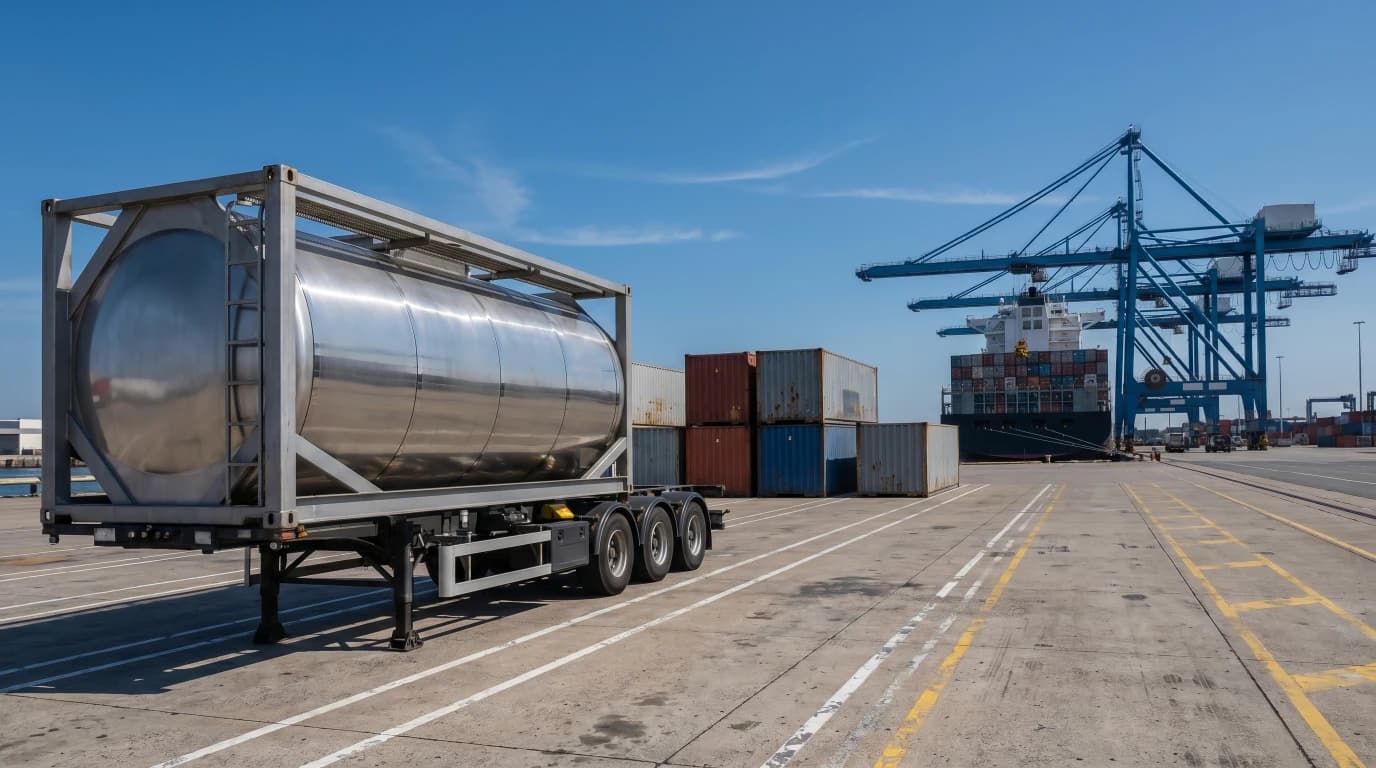
Latflex is a Riga-based specialty freight forwarder moving vegetable oils, grains, oilseeds, fertilizers, and other agri-commodities through Baltic and Black Sea gateways into Central Asia and the CIS. They operate flexitanks, ISO tanks, IBCs, and cross-pumping services at Riga and Poti, and serve commodity traders shipping out of Rotterdam, the Black Sea, and inland EU origins. Like most specialty forwarders, the operation is lean: a small senior team carrying decades of pricing and equipment intuition, a single sales inbox, and a stack that is essentially Outlook plus Excel plus an accounting tool.
Latflex engaged Particula for a focused, time-boxed diagnostic: a two-week AI Operations Audit covering the full company. The mandate was not to pick a tool, build a prototype, or recommend a platform: it was to map the entire operating workflow, measure where senior time and margin are leaking, and produce a ranked, ROI-modelled roadmap of where AI moves the needle next. The deliverable was a written audit and a prioritised opportunity backlog. No code was shipped, by design.
This case study documents the audit methodology, the seven opportunities the diagnostic surfaced, and the roadmap we handed over. It is published with Latflex's permission. The same audit is available as a productized engagement for comparable forwarders, 3PLs, and specialty desks, the methodology and the opportunity shape generalize cleanly across the segment.
The Mandate
Latflex's senior team had a working hypothesis going in: that AI could compress quote turnaround. They were right, but they were also asking the wrong-sized question. The right question for a forwarder of this shape is not 'where does AI help with X': it is 'across the full operation, what are the three to seven places where AI delivers measurable value, and in what order should we deploy them.'
We re-scoped the engagement on day one from a single-workflow study to a full operations audit, capped at two weeks and a fixed fee. The deliverable shape was set up front: a written audit (workflow map, baselines, opportunities, recommended sequencing, ROI model, build estimates) and a working session to walk the senior team through it. No tooling work in scope. No platform pitch. No vendor lock-in.
Methodology
The audit was structured around four parallel tracks running across the two weeks.
Workflow shadowing. We sat with senior operators and tracked, end-to-end, every recurring activity: inbound enquiries, quoting, booking, equipment sourcing, document handling, customs interfaces, invoice reconciliation, dispatch, post-shipment follow-up. Every step was timed against a representative sample of live work.
Inbox archaeology. With permission, we sampled and categorised a multi-month slice of the main sales inbox. Every email was tagged by intent (RFQ / track-and-trace / document request / invoice query / customs / internal / lead / spam). The mix told us where the team's reactive attention actually goes, which is rarely where they think it goes.
Win/loss analytics. We ran a structured review of historical quotes against booking outcomes, controlling for lane, equipment, customer segment, and quoting latency. The objective was to identify the actual conversion levers, price, response time, equipment match, communication tone, rather than relying on the team's intuition.
Vendor & system map. Every external system, supplier, data source, and information flow was mapped: carrier rate sources, port tariff PDFs, terminal portals, customs interfaces, the accounting tool, the bank, the spreadsheets, and where the team's institutional memory lives. The map made it explicit which integrations would be cheap and which would be hard.
Findings from all four tracks were cross-referenced against public industry benchmarks (Freightos, Transport Intelligence, McKinsey, FourKites, Project44, DHL Trend Radar) so that every opportunity in the roadmap could be sized credibly against the segment, not just against Latflex's own n=1.
The Findings, Seven Opportunities Ranked
The audit surfaced seven AI opportunities with a credible business case. Each was sized on a measured baseline from the diagnostic plus a projected impact range anchored in industry benchmarks. The table below is the headline artifact from the engagement, lightly redacted for confidentiality.
Opportunities are ranked by a composite of expected ROI, technical complexity, time-to-value, and how cleanly they sequence with each other. Two-of-seven (#1 and #2) account for the bulk of the projected senior-time recovery in the first six months.
| Rank | Opportunity | Measured Baseline | Projected Impact | Complexity | Time-to-Value |
|---|---|---|---|---|---|
| 1 | AI Quoting Co-Pilot | ~75 min median per RFQ; ~40% of senior time spent on quoting | Drafting time down to single-digit minutes; pricing-error leakage of 2–5% of margin recovered (per McKinsey/Freightos benchmark) | Medium | 8 weeks |
| 2 | Inbound Email Triage | ~25–30% of inbox is non-RFQ traffic (track-and-trace, document requests, invoice queries) | ~25% CSR capacity recovered (FourKites/Project44 benchmark for visibility-query automation) | Medium | 6 weeks |
| 3 | Rate Knowledge Base | Rates fragmented across carrier PDFs, broker emails, spreadsheets, and team memory | Single source of truth; eliminates stale-rate quoting and underwrites #1 | Low | 4 weeks |
| 4 | Document Intake (BOL / CMR / COA) | ~15–30 min per shipment in manual re-keying with a 2–5% error rate | 70%+ reduction in data-entry time; structured shipment data feeds downstream | Medium | 6 weeks |
| 5 | Demurrage & Detention Watchdog | Free-time clocks tracked manually across multiple ports; D&D cost a known leak | 3–8% of transport cost recovered on at-risk shipments (Container xChange 2024 benchmark) | High | 10–12 weeks |
| 6 | Trade-Show Lead Capture & Enrichment | 30–50% of trade-show leads (VegOil, Baltic Grains) decay before structured follow-up (HubSpot/Salesforce SMB benchmark) | Structured pipeline + enrichment; recovered lead value | Low | 4 weeks |
| 7 | DG / Sanctions Screening Assist | Manual screening, high audit risk, single-mistake exposure | Audit-grade automation with human-in-the-loop sign-off | High | 10–12 weeks |
Top Three in Detail
#1, AI Quoting Co-Pilot. Workflow shadowing measured a median of just over an hour of senior time per RFQ: read, classify, look up rates across carrier PDFs and port tariffs, calculate surcharges, draft a reply. Half of that hour was clerical. The win/loss review surfaced a quieter finding: response latency, not headline price, was the dominant predictor of conversion on repeat-customer lanes. The recommendation is a senior-operator-in-the-loop drafting tool, not a self-serve portal, not a TMS replacement. The co-pilot reads the inbound enquiry, recommends equipment with rationale, composes a sourced rate with a margin guardrail, and drafts a reply in the team's voice. The operator reviews and sends.
#2, Inbound Email Triage. Inbox archaeology found that roughly a quarter to a third of inbound mail in the main sales inbox is not an RFQ at all: it is track-and-trace ('where is my container'), document requests (BOL/CMR/COA copies), invoice queries, and customs follow-ups. Industry reporting from FourKites, Project44, and DHL converges on visibility queries as the largest single CSR cost in freight forwarding. The recommendation is a triage co-pilot that classifies every incoming email, extracts reference numbers from attached BOL and CMR documents, and drafts replies for the routine cases. Non-routine mail is escalated with the context already pulled. The same infrastructure scaffolding stood up for #1 carries most of #2, which is why we sequenced them adjacently in the roadmap.
#3, Rate Knowledge Base. The audit's vendor/system map exposed rate fragmentation as the silent tax on every other workflow. There is no single source of truth: rates live in carrier PDFs, broker emails, spreadsheets, and the senior team's memory of what was quoted last month. This is the cheapest opportunity on the list to deliver in isolation, and it is also a hard prerequisite for #1 and a soft prerequisite for #5. We deliberately recommend doing #3 first or in parallel with #1, not after, because every week of #1 building against fragmented rates is a week of rework.
The Roadmap We Handed Over
The roadmap sequences the seven opportunities into three waves over the first six to nine months post-audit, with explicit decision gates between waves so the team can reassess after each.
Wave 1 (Weeks 1–10). Rate Knowledge Base (#3) in parallel with the start of the AI Quoting Co-Pilot (#1). Wave 1 ships the highest-leverage commercial improvement and the foundational data layer in one stroke.
Wave 2 (Weeks 8–16). Inbound Email Triage (#2) reusing #1's inbox integration and classifier scaffolding. Document Intake (#4) follows because the BOL/CMR extractor in #2 is most of #4. Trade-Show Lead Capture (#6) is a small adjacent build that runs in parallel.
Wave 3 (Weeks 16–26). Demurrage & Detention Watchdog (#5) and DG/Sanctions Screening Assist (#7), the two higher-complexity items. Wave 3 starts only after Waves 1 and 2 have validated their projected impact in production.
Every wave has explicit success criteria and a kill-or-continue decision gate. The roadmap is sequenced for cumulative compounding, each wave's infrastructure is reused by the next.
Where This Generalizes
Latflex is the proof that the AI Operations Audit pattern works on a specialty liquid-bulk forwarder. It is not the boundary of where the pattern applies. The same two-week diagnostic, the same four methodology tracks, and broadly the same seven-opportunity backlog show up across SMB and mid-market freight forwarding more generally: ISO-tank specialists, agri-commodity desks, LCL consolidators, project cargo teams, reefer specialists, conventional NVOCCs, and small/mid 3PLs.
What changes between segments is the relative ranking of the seven and the equipment/commodity logic underneath each. What does not change is the shape of the pain (email-driven RFQs, fragmented rate sources, visibility queries crowding out commercial work, document re-keying, D&D leakage) or the shape of the diagnostic (shadowing, inbox archaeology, win/loss analytics, vendor map).
If your commercial team lives in Outlook and Excel, if your senior operators feel like the bottleneck of the entire operation, if you suspect AI helps but cannot rank where to start, this is the engagement to buy first. The audit is fixed-fee, two weeks, and produces a written deliverable you can act on regardless of who builds the recommendations. Particula is one option for the build; the roadmap stands on its own.
- AI Audit
- Logistics
- Freight Forwarding
- Liquid Bulk
- Operations Diagnostic
- AI Consulting
- Roadmap