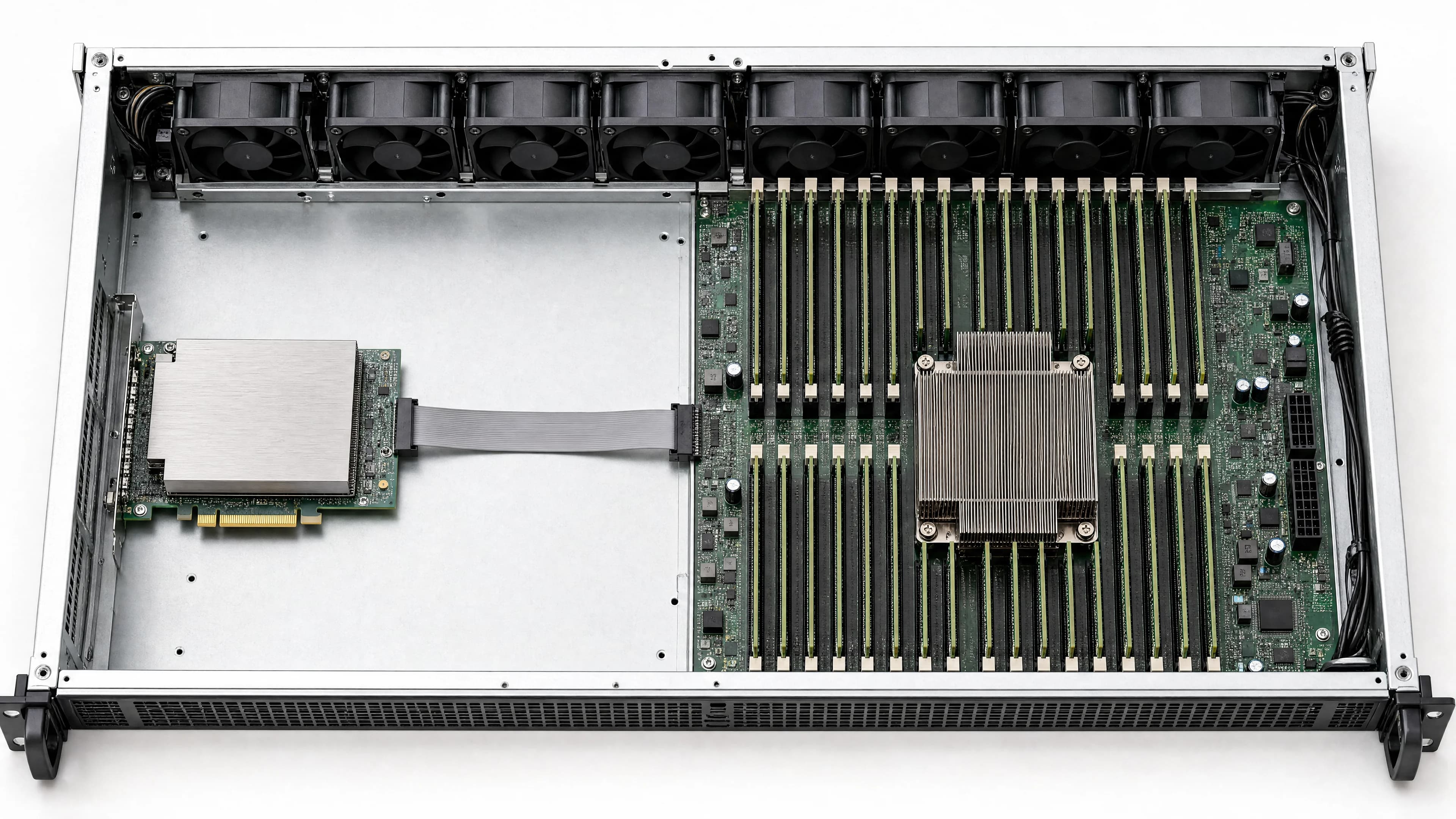

DGX Spark has 128 GB of unified memory at 273 GB/s, lists at about $7,000 per press coverage of an October 2, 2026 price increase, and up to four units link to 512 GB. Mac Studio with M5 Ultra reads memory at 1.2 TB/s, starts at $5,499 with 96 GB, and its 512 GB configuration became orderable on October 28, 2026 at a $22,299 list price per launch coverage. A Ryzen AI Max+ 395 (Strix Halo) box tops out at 128 GB, with up to 96 GB available for graphics per AMD. On spec-sheet arithmetic alone, the M5 Ultra's decode ceiling on a 4-bit 70B dense model is about 34 tokens per second against about 7.8 on a Spark, an upper bound and not a measurement. For a regulated team the bandwidth gap matters less than carry-over: Spark runs DGX OS with CUDA and NGC containers for vLLM and TensorRT-LLM, the same engines as H100 and B200 production servers, while evaluation results from MLX on a Mac or ROCm and Vulkan on Strix Halo have to be re-run on the target stack before sign-off. Buy the Spark as a validation rig for an NVIDIA deployment, the M5 Ultra for single-user work on the largest models, and Strix Halo only as a low-cost sandbox. This week, write down your production serving stack and the largest model you must evaluate, then match the stack first and the capacity second.
The usual DGX Spark vs Mac Studio comparison is a bandwidth contest, and on bandwidth it is not close. NVIDIA's DGX Spark reads its 128 GB of unified memory at 273 GB/s. Apple's Mac Studio with M5 Ultra reads up to 512 GB at 1.2 TB/s, about 4.4 times faster, and the 512 GB configuration became orderable on October 28, 2026. If token generation speed for one user on one huge model is the only question, the Mac wins and the comparison is over.
For a team at a bank, an insurer, a hospital group or a manufacturer, that is not the question. The box goes inside the perimeter so engineers can run open-weight models on real data before anyone signs a datacenter purchase order. That makes three other things decide the purchase: whether results gathered on the box carry over to the production GPU stack, whether IT can manage and audit it under existing controls, and whether it grows to the model size you need at a known list price.
Judged that way, the verdict splits. DGX Spark wins carry-over: it runs the same CUDA, vLLM and TensorRT-LLM stack as H100 and B200 servers. Mac Studio with M5 Ultra wins capacity in one box and single-stream decode. A Ryzen AI Max+ 395 box, the chip practitioners call Strix Halo, is the low-cost 128 GB option with the weakest software carry-over of the three.
DGX Spark vs Mac Studio vs Strix Halo: the spec sheet
Every figure below comes from the vendor's own product page or announcement. Where a vendor publishes no number, the cell says so rather than borrowing one from a review.
Three entries need a caveat before they mislead anyone.
The DGX Spark's 1 PFLOP is FP4 with sparsity, labelled theoretical by NVIDIA. NVIDIA does not publish a dense figure on the product page, so do not halve it and print the result as a spec.
The 128 GB M5 Max is a 614 GB/s machine. Apple ties the 128 GB option to the 40-core GPU, which is the faster memory configuration. On the M5 Ultra, 1.2 TB/s applies to both the 30-core and 36-core chips, but 256 GB and 512 GB require the 36-core CPU and 80-core GPU. A 96 GB base unit cannot be upgraded to 256 GB later on the same chip, so order the capacity you need on day one.
Strix Halo's 256 GB/s is arithmetic: 8000 MT/s times 256 bits, divided by 8. AMD's press material also caps the memory available to graphics at 96 GB of the 128 GB, which matters more for model sizing than the bandwidth figure does.
| DGX Spark | Mac Studio M5 Max | Mac Studio M5 Ultra | Ryzen AI Max+ 395 box | |
|---|---|---|---|---|
| Max unified memory | 128 GB LPDDR5x (64 GB variant via OEMs) | 128 GB (requires 40-core GPU) | 96 GB base; 256 or 512 GB on 36/80-core chip | 128 GB, up to 96 GB for graphics |
| Memory bandwidth | 273 GB/s, 256-bit | 460 GB/s (32-core GPU), 614 GB/s (40-core GPU) | 1.2 TB/s on both chips | 256 GB/s theoretical, derived from 256-bit LPDDR5x-8000 |
| Compute claim | Up to 1 PFLOP FP4, theoretical, with sparsity | No TFLOPS published | No TFLOPS published | 50 TOPS NPU; 40-CU Radeon 8060S GPU |
| CPU | 20-core Arm (10 X925 + 10 A725) | 18-core | 30-core or 36-core | 16 Zen 5 cores |
| Power | 140 W GB10 TDP, 240 W supply | 480 W max continuous (Mac Studio) | 480 W max continuous (Mac Studio) | 45 to 120 W configurable TDP |
| Operating system | DGX OS (Ubuntu-based) | macOS | macOS | Windows or Linux, by OEM |
| Linking | ConnectX-7, two QSFP ports up to 200 Gb/s | Thunderbolt 5, up to 120 Gb/s | Thunderbolt 5, up to 120 Gb/s | OEM-dependent |
| Max linked capacity | 4 units, 512 GB (switch needed for 4) | Clustering via Thunderbolt 5 and RDMA | Clustering via Thunderbolt 5 and RDMA | Not vendor-documented |
| US list price | About $7,000 (128 GB) per press coverage of the October 2, 2026 increase; 64 GB from $4,999 via OEMs | From $2,499 (36 GB) | From $5,499 (96 GB) | Varies by OEM |
Why decode speed follows memory bandwidth
LLM inference has two phases with different limits. Splitwise, a 2023 paper on phase-split serving, describes them as "a compute-intensive prompt computation, and a memory-intensive token generation" (arXiv 2311.18677). A later survey uses a roofline model to analyse why LLM inference is memory-bound (arXiv 2402.16363).
For decode the consequence is simple arithmetic. Generating one token for one user reads every active weight once, so the ceiling is memory bandwidth divided by the bytes of weights read per token. A 4-bit model stores about half a byte per parameter.
The table below applies that division to two generic model shapes: a 70B dense model at 4-bit (about 35 GB read per token) and a mixture-of-experts model with about 10B active parameters at 4-bit (about 5 GB per token). It is a theoretical ceiling from published bandwidth. These are not measurements: real single-stream decode lands below them because the KV cache also has to be read, kernels never hit peak bandwidth, and the software stack adds overhead.
Two readings follow. First, the ranking is fixed by the bandwidth column: whatever the software does, a Spark will not out-decode an M5 Ultra on a single stream of a model that fits both. Second, model architecture moves the numbers more than hardware choice does. A sparse MoE on a Spark has a higher ceiling than a dense 70B on an M5 Ultra, which is why sparse MoE models are the natural fit for all of these boxes.
Prefill, the prompt-processing phase, is compute bound, and it cannot be compared across these vendors from spec sheets. NVIDIA publishes only the sparse FP4 peak for GB10. Apple publishes no TFLOPS for M5 Max or M5 Ultra, only relative claims: up to 4x faster LLM prompt processing in LM Studio than the M3 Ultra and up to 9.8x faster than the M1 Ultra, from Apple's own July 2026 testing. AMD's announcement gives NPU TOPS but no GPU TFLOPS. What can be said from first principles is that Spark's Blackwell Tensor Cores with native FP4 are built for exactly that compute-bound phase. For the latency targets a shared deployment needs to hit, see what TTFT and tokens per second targets to set.
| Box | Published bandwidth | 70B dense, 4-bit (bandwidth / 35 GB) | ~10B active MoE, 4-bit (bandwidth / 5 GB) |
|---|---|---|---|
| DGX Spark | 273 GB/s | ~7.8 tok/s ceiling | ~55 tok/s ceiling |
| Ryzen AI Max+ 395 | 256 GB/s (derived) | ~7.3 tok/s ceiling | ~51 tok/s ceiling |
| Mac Studio M5 Max (40-core GPU) | 614 GB/s | ~17.5 tok/s ceiling | ~123 tok/s ceiling |
| Mac Studio M5 Ultra | 1,200 GB/s | ~34 tok/s ceiling | ~240 tok/s ceiling |
DGX Spark vs Mac Studio price by memory size, October 2026
All three boxes start at or near 128 GB, and the arithmetic of weights times bytes per parameter says what fits. 128 GB holds a 70B dense model at 8-bit (about 70 GB) or roughly 200B parameters at 4-bit (about 100 GB) with room left for KV cache and the operating system. Past about 230B parameters at 4-bit you need the 256 GB tier. The 512 GB tier is for the largest open-weight MoE models at low-bit quantization. On Strix Halo, size against AMD's 96 GB graphics figure, not the full 128 GB.
The paths up from 128 GB are different in kind:
The Spark price has moved twice in 2026. In late February NVIDIA raised the Founders Edition MSRP from $3,999 to $4,699 across all regions, citing worldwide memory supply constraints, with no hardware change. On October 2, press coverage reported a second increase for the 128 GB model to about $7,000, the same day NVIDIA announced a 64 GB configuration sold only through OEM partners from $4,999, on sale from October 23. Any $3,999 or $4,699 quote predates those changes. The 512 GB Mac price comes from launch coverage of the October 28 store opening: the 36-core CPU and 80-core GPU chip at $6,799, plus $15,500 for 512 GB. Treat $22,299 as a reported list price at order opening. The 512 GB model is orderable; this comparison makes no claim about delivery dates.
Per gigabyte the two paths are close up to 256 GB, about $55 for Sparks against $57 for the base M5 Ultra, and at 512 GB the single Mac is cheaper: $22,299 against about $28,000 for four Sparks before the switch. The gigabytes are not equivalent either. Four linked Sparks are four 128 GB pools joined by 200 Gb/s links, which is 25 GB/s per port, about a tenth of each box's local memory bandwidth. A model split across them pays that cost on every crossing. One 512 GB M5 Ultra is one pool at 1.2 TB/s. Apple's own figure for a four-Mac cluster, up to 3x faster AI inference than one system over Thunderbolt 5 at 120 Gb/s, is the same lesson from the other vendor: linking scales sub-linearly. Link boxes for capacity, not for speed.
For a worked example of a very large MoE squeezed into a 256 GB Mac Studio, see our GLM-5.2 local runbook. If the real question is whether owning any of this beats paying per token, that math is in self-hosted LLM vs API break-even, and we will not redo it here.
| Tier | DGX Spark path | Mac Studio path | List price, as of October 30, 2026 | List price per GB |
|---|---|---|---|---|
| 96 to 128 GB | One Spark | M5 Ultra 96 GB base (or 128 GB M5 Max) | Spark about $7,000; M5 Ultra base $5,499 | Spark ~$55; M5 Ultra base ~$57 |
| 256 GB | Two Sparks, one direct QSFP cable | M5 Ultra 256 GB on the 36/80-core chip | Two Sparks about $14,000 plus cable; 256 GB Mac price not confirmed | Sparks ~$55 |
| 512 GB | Four Sparks plus a 200GbE switch | M5 Ultra 512 GB, orderable since October 28, 2026 | Four Sparks about $28,000 plus switch; M5 Ultra 512 GB $22,299 per launch coverage | Sparks ~$55 before switch; Mac ~$44 |
Which box matches your production GPU stack
This is the section that should decide the purchase for a regulated team.
A desk box in a regulated environment produces evidence: accuracy on your evaluation set at a given quantization, refusal behaviour, latency at a given context length. That evidence feeds model risk review and, eventually, a production sign-off. It is only worth what it predicts about the production system.
DGX Spark: the same engines and formats as the servers
DGX Spark runs DGX OS, an Ubuntu-based Linux distribution, with NVIDIA's CUDA stack. NVIDIA's own documentation says the latest features and performance improvements arrive through NGC containers, naming PyTorch, vLLM and TensorRT-LLM. NVIDIA also publishes DGX Spark playbooks for vLLM, SGLang, llama.cpp, NIM, multi-node clustering, fine-tuning and NVFP4 quantization. Those are the engines, kernels and number formats that run on H100 and B200 production servers. An FP8 accuracy result on a Spark reflects the format an H100 server runs, an NVFP4 result reflects the format a Blackwell server such as B200 runs, and a serving configuration validated there moves to the datacenter with changes in scale rather than in kind. For how the serving engines themselves differ on the production side, see our vLLM vs Ollama vs TensorRT-LLM comparison. Carry-over is not perfect. GB10 is an integrated GPU on unified memory, so standard GPU memory dashboards read differently: NVIDIA's known-issues page says the usual memory readout shows as not supported and that the CUDA memory query can under-report what is allocatable. Absolute throughput is also far below a datacenter card. What carries over is correctness, formats and configuration, not speed.
Mac Studio: different kernels, different formats
On a Mac the native stack is MLX, Apple's array framework for Apple silicon, and llama.cpp with its Metal backend. vLLM's documentation lists Apple Silicon support only through a community-maintained plugin that uses MLX as the compute backend, not the mainline CUDA path. The quantization formats are MLX's own or llama.cpp's GGUF, and neither is what an NVIDIA production server runs. An accuracy number measured on a 4-bit MLX model tells you about that model in that format, and it has to be re-measured on the production format before anyone signs off on it.
Strix Halo: the narrowest official support
AMD's ROCm compatibility page for Radeon and Ryzen lists the Ryzen AI Max+ 395 as supported on specific Ubuntu releases only, with PyTorch as the only listed framework and only FP16 officially validated. The main ROCm system requirements table for Instinct and Radeon PRO cards does not list the chip. vLLM's own documentation lists support for this GPU family from ROCm 7.0.2, which is vLLM's claim rather than AMD's. The alternative path is llama.cpp over Vulkan. Either way, results transfer to an NVIDIA production fleet even less directly than Mac results do. The practical rule: if production will run on NVIDIA servers, every evaluation you run on a Mac or a Strix Halo box is a draft that must be re-run on the target stack. If you will do that re-run anyway, the Mac's capacity and bandwidth can earn their price. If you want the desk box to be the place where the evidence is produced, buy the Spark.
Managing DGX Spark and Mac Studio in a regulated environment
The second question is who owns the box. A machine holding real customer, patient or claims data is in scope for the same controls as any other system that touches it: patching, access, logging, encryption at rest, and an inventory entry.
NVIDIA documents DGX Spark as an enterprise endpoint managed with an appliance mindset. Its fleet lifecycle guide covers agentless management over SSH, provisioning with cloud-init, updates in maintenance windows rolled out in staged rings with pre-check and post-check evidence, and Canonical Landscape as the recommended management platform, with Ansible, Puppet and Tanium usable but supported by their own vendors. The manageability guide covers air-gapped installation from a local package repository and firmware mirror. Storage is self-encrypting NVMe up to 4 TB. DGX OS major updates arrive around February and August for the first two years after release, with security patches in between. NVIDIA is also explicit about what stays with you: identity and access control, secrets, change management, artifact retention and legal hold, and network segmentation. Once the stack is validated, running it fully offline follows the same pattern as our air-gapped vLLM deployment guide.
A Mac Studio is managed as an endpoint. Apple's deployment guide describes mobile device management that configures devices remotely, updates software and settings, monitors compliance with organisational policies, and can lock or wipe a machine. That fits a single developer's machine neatly, because it rides on the same MDM that already manages your laptops. It fits a shared server less well, and Mac clustering adds a manual step: MLX's distributed documentation says RDMA over Thunderbolt, needed by its low-latency backend for tensor parallelism, must be enabled from macOS recovery on each machine and cannot be turned on remotely, even with administrator rights.
A Strix Halo box is a commodity mini PC or workstation. Firmware, BIOS updates and manageability features depend on the OEM, so the controls you get depend on the model you buy. Check the vendor's firmware update channel and remote management support before the data owner asks.
Write down three answers before the box arrives, whichever you buy: who patches it and on what schedule, where its access and inference logs go, and whether more than one person logs into it. The third answer decides between endpoint management and server management.
Single developer vs shared team LLM server
Usage pattern changes the hardware answer as much as carry-over does.
Single developer on large models
One engineer exploring the largest open-weight MoE models, mostly long single-stream generation, is the M5 Ultra's home ground. Single-stream decode is bandwidth bound, the M5 Ultra has about 4.4 times the Spark's bandwidth, and 512 GB in one box avoids splitting a model across a network link. The cost is the carry-over problem above.
A shared office server
A small team sharing one box behaves differently. Retrieval-augmented question answering and agent workloads send long prompts and get short answers, so the work is dominated by prefill, which is compute bound and benefits from batching many requests together. That favours the Spark: Tensor Cores with FP4 for the compute-bound phase, and continuous-batching engines such as vLLM and SGLang with NVIDIA-published playbooks. Long contexts also stress unified memory in ways spec sheets hide. A published third-party benchmark on a GB10 found prompt processing collapsing at long context with a quantized KV cache, covered in our KV cache quantization benchmarks. On any unified-memory box, including Strix Halo and Apple silicon, prompt caches compete with weights for the same pool, a point covered in prompt reprocessing on hybrid models.
When neither is a server
Past roughly a team's worth of concurrent users, or when you need production-grade uptime, none of these boxes is the right tool. The step up is a PCIe server card in a rack, compared in our RTX PRO 6000 vs H100 vs L40S guide. A desk box is for development, evaluation and light shared use, and buying one to postpone a server purchase that the usage already justifies only moves the cost.
DGX Spark vs RTX Spark: different products
NVIDIA's RTX Spark is a different product with a similar name. It is a Windows 11 platform for slim laptops and compact desktops, launched at events on October 16, 2026, with laptops from ASUS, Dell, HP, Lenovo, Microsoft and MSI. NVIDIA lists up to 128 GB of unified memory for both laptops and desktops, with NVIDIA claiming up to 1 petaflop of FP4 AI performance; NVIDIA publishes no memory bandwidth for it. It is a Windows developer endpoint that runs models locally, not a DGX OS box and not a shared server. If your engineers need a laptop that runs a mid-size model offline, it belongs on that shortlist. It does not replace a DGX Spark as a validation rig.
DGX Spark or Mac Studio: which to buy for which job
Our LLM and models guide collects the rest of our work on sizing, quantization and serving open-weight models on your own hardware.
This week, write two things on one page: the serving stack your production deployment will run (engine, GPU vendor, quantization format) and the largest model you must evaluate before sign-off. Match the box to the first line, then size it to the second. If the first line says NVIDIA and vLLM, the Spark is the default and the M5 Ultra has to justify itself on capacity alone.
| Use case | Pick | Why | What to watch |
|---|---|---|---|
| Validation rig for an NVIDIA production deployment | DGX Spark | Same CUDA, vLLM and TensorRT-LLM stack and FP8 or FP4 formats as H100 and B200 servers | Absolute speed is far below production; validate correctness and formats, not throughput |
| Single-developer evaluation of the largest MoE models | Mac Studio M5 Ultra, 256 or 512 GB | 1.2 TB/s bandwidth and up to 512 GB in one pool | Results in MLX or GGUF formats must be re-run on the production stack |
| Shared office server for a small team | DGX Spark, linked to a second unit if models exceed 128 GB | Compute for prefill-heavy traffic, batching engines with NVIDIA playbooks, Linux server management | Linking adds capacity at 25 GB/s per port, not speed |
| Lowest-cost 128 GB sandbox | Ryzen AI Max+ 395 box | 128 GB at a lower price point, llama.cpp over Vulkan | Up to 96 GB for graphics; ROCm officially validated for PyTorch and FP16 only |
| More than 512 GB, or more than a handful of concurrent users | PCIe server cards | Desk boxes are development hardware, not production servers | Covered in the server card comparison linked above |
FAQ
Quick answers to the questions this post tends to raise.